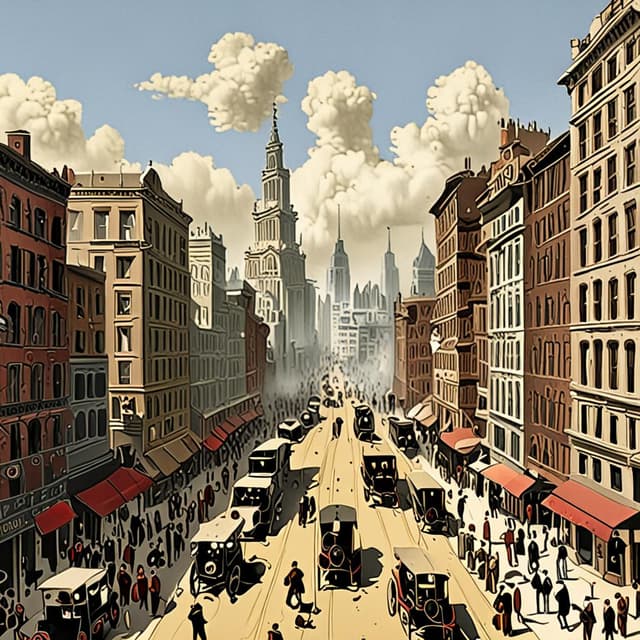
| Period | Early 20th century |
| Challenges | Tensions remained, but absence of total war |
| Characteristics | Relative peace • Stability • Optimism • Technological progress • Economic growth • Cultural flourishing |
| Dominant powers | British Empire • Colonial system |
As the 20th century dawned, the world found itself in a remarkably different state than our own timeline. The great powers of Europe - the United Kingdom, France, Germany, Austria-Hungary, Italy and the Russian Empire - remained intact, without the cataclysmic upheavals of the First World War or the Russian Revolution. Similarly, the British Empire continued its global dominance, with an unbroken colonial network spanning the planet. This confluence of factors ushered in an era of relative peace, stability and optimism across much of the world in the early 1900s.
The avoidance of a total European war was due in large part to a series of diplomatic negotiations and compromises known as the "White Peace" of 1910-1914. Rather than erupting into an all-out conflagration, the various territorial disputes, imperial rivalries and nationalist tensions that had been building for decades were instead defused through a combination of backroom deals, concessions and a shared recognition among the powers that a general war would devastate them all.
Germany was granted limited colonial expansion in Africa, while Austria-Hungary was allowed to annex Bosnia and Herzegovina. The Ottoman Empire, increasingly weak, ceded territory to its neighbors. And the Russian Empire, though maintaining its autocratic monarchical system, was placated with promises of gradual reform and greater influence in the Balkans. This "White Peace" ushered in an era of relative tranquility known as the ''Pax Europa'', with the major powers focusing inward on industrialization, infrastructure development and cultural flourishing rather than external conflicts.
Freed from the immense human and material costs of total war, the early 20th century saw rapid economic growth and technological advancement across much of the industrialized world. The Second Industrial Revolution continued apace, with new innovations in electricity, internal combustion engines, chemistry and communications transforming daily life. The British Empire in particular leveraged its global trade networks to amass wealth and finance ambitious engineering projects like the Aswan Low Dam and the Sydney Harbor Bridge.
This period also witnessed the rise of new economic and social theories, from Keynesian economics to social democracy. While class tensions and labor unrest remained issues, the absence of catastrophic war allowed for more gradual reform and a growing middle class in many countries. Consumerism and mass media began shaping popular culture, with the Jazz Age and the advent of radio broadcasting epitomizing the era's vibrancy.
Unconstrained by the trauma and disillusionment that followed the First World War in our timeline, the early 1900s saw a flourishing of the arts, sciences and intellectual discourse. Modernism in literature, music and the visual arts advanced in innovative new directions, with movements like Cubism, Expressionism and Futurism gaining prominence. Physics, biology and psychology made major breakthroughs, and technological utopianism became a prevalent cultural narrative.
At the same time, the British Empire continued its steady global expansion, bringing more territories under its sway through a mix of economic, political and occasionally military means. India, Africa, Australia and Canada remained key colonial possessions, while the Empire also extended its reach into the Middle East and Southeast Asia. This allowed Britain to amass immense wealth and influence, though growing nationalist movements in the colonies foreshadowed future challenges.
Of course, this alternate 20th century was not without its own trials and tribulations. Class conflicts, nationalist agitations, and ideological divides simmered beneath the surface, occasionally erupting into unrest or violence. The Russian Empire remained an autocratic state rife with repression, while conservative forces resisted social reforms in many countries. Racial and ethnic prejudices also persisted, manifesting in discriminatory laws and practices, particularly within the colonial system.
Additionally, the lack of a catastrophic world war did not mean the complete absence of armed conflicts. Smaller regional wars, proxy battles, and colonial skirmishes occurred with some regularity, though they tended to be more limited in scope. And the technological advances of the era, from chemical weapons to strategic bombing, foreshadowed the dangers of future conflagrations.
Yet despite these challenges, the early 20th century in this alternate timeline was marked by a palpable sense of optimism and progress. With the flowers of a new age seemingly poised to blossom, many looked towards the future with hope and expectation, envisioning a world of unparalleled prosperity, scientific wonders, and cultural efflorescence. How long this idyllic vision would last, however, remained an open question.
