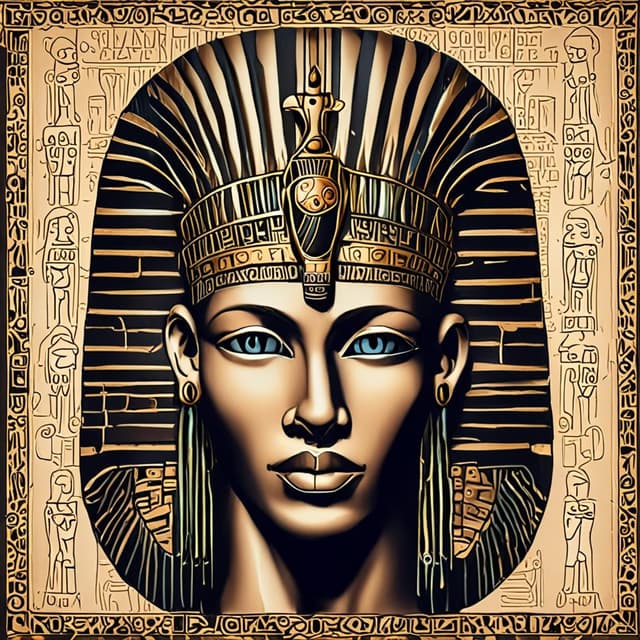
| Name | Ancient Egypt |
| Impact | Influential on neighboring societies |
| Duration | c. 3100 BCE - 30 BCE |
| Location | Nile River valley, North Africa |
| Expansion | Gradual expansion of territorial control and cultural influence across North Africa and the Near East |
| Renowned for | Sophisticated religious beliefs • Architectural wonders • Technological innovations • Cultural sophistication |
Ancient Egypt was one of the earliest and most influential civilizations to arise in the ancient world, with a continuous cultural history spanning over three thousand years. Originating in the Nile River valley of northeastern Africa, the Egyptian empire gradually expanded its territorial control and cultural influence across North Africa and the Near East, becoming one of the most powerful and technologically advanced societies of its time.
The foundations of Egyptian civilization were laid by a series of prehistoric cultures that emerged along the Nile during the Neolithic and Chalcolithic periods, from around 6000 to 3100 BCE. These early Nile valley societies developed advanced agricultural techniques, established permanent settlements, and created some of the earliest examples of monumental architecture, such as the Nabta Playa stone circles.
The unification of Upper and Lower Egypt under the rule of the first pharaoh, Narmer, around 3100 BCE is considered the starting point of thedynastic period of ancient Egyptian history. Over the following centuries, a succession of dynasties and kingdoms would rise and fall, each contributing to the growing sophistication and power of the Egyptian state.
During its peak, the Egyptian empire extended far beyond the Nile valley, encompassing territories in Libya, Nubia, the Levant, and the Aegean. This expansionist policy was driven by the Egyptians' desire to control vital trade routes, secure natural resources, and project their cultural and political influence across the ancient world.
The Egyptian state was characterized by a highly centralized, autocratic system of government headed by the divine monarch of the pharaoh. A sprawling bureaucracy of scribes, priests, and administrators oversaw the day-to-day functioning of the empire, while a powerful military force subjugated conquered territories and defended against foreign invaders.
Religion was the foundation of ancient Egyptian civilization, with a vast pantheon of deities and a belief system centered around the afterlife and the cyclical nature of existence. The construction of massive temple complexes, elaborate tombs, and colossal statues of the gods were expressions of the Egyptians' profound religious devotion.
Egyptian culture was also renowned for its achievements in the arts, architecture, and technology. The Egyptians developed a sophisticated hieroglyphic writing system, created masterpieces of painting and sculpture, and engineered some of the most impressive architectural wonders of the ancient world, including the Great Pyramids of Giza and the sprawling temple complexes of Karnak and Luxor.
The ancient Egyptians made significant contributions to numerous fields of science and technology, including mathematics, astronomy, medicine, and engineering. Their mastery of hydraulic engineering allowed them to harness the power of the Nile for irrigation and flood control, while their advancement in shipbuilding and navigation facilitated extensive maritime trade.
The Egyptians' understanding of astronomy was also highly sophisticated, as evidenced by their ability to accurately track the movements of celestial bodies and develop a calendar system based on the annual flooding of the Nile. This astronomical knowledge was integrated into their religious beliefs and rituals, further reinforcing the centrality of the cosmos in Egyptian worldview.
The civilization of ancient Egypt left an indelible mark on the ancient world and continues to captivate the modern imagination. The grandeur and technological achievements of the Egyptian empire have inspired countless later civilizations, from the Persians and Greeks to the Romans and Byzantines.
Even as the Egyptian state eventually succumbed to foreign conquest and internal strife, the cultural and intellectual legacy of this remarkable civilization endured. The influence of Egyptian art, architecture, religion, and scientific knowledge can be seen in the cultural development of many neighboring societies, making ancient Egypt one of the most transformative and far-reaching civilizations in human history.
