| Name | Ecotopia |
| Type | Autonomous city-state |
| Status | Influential model for green cities and eco-communities worldwide |
| Founded | Late 18th century |
| Founder | Émile Réaumur, French philosopher-engineer |
| Purpose | Radical experiment in sustainable living and ecological transformation |
| Location | Within New Netherland |
| Key features | Comprehensive urban planning • Renewable energy system • Communal agriculture • Decentralized governance • Environmentally harmonious and socially equitable society |
Ecotopia is an autonomous city-state and social experiment situated within the larger nation of New Netherland. Founded in the 1770s by French philosopher and engineer Émile Réaumur, Ecotopia has emerged as a pioneering model of sustainable living and ecological urban design. Drawing inspiration from the democratic revolutions sweeping Europe and North America at the time, Réaumur envisioned Ecotopia as a radical alternative to the industrialized, polluted, and socially inequitable cities that were rapidly spreading.
In 1771, Réaumur presented his concept for an "ecological utopia" to the governing authorities of New Netherland, proposing to establish an autonomous, self-governing community dedicated to living in harmony with nature. After years of negotiation and planning, Réaumur's vision was granted approval, and construction on the new city began in 1775 on a tract of land along the Hudson River north of New Rotterdam.
Réaumur's original plan called for Ecotopia to be a self-sufficient, decentralized "garden city" built around principles of renewable energy, organic agriculture, and participatory democracy. The city's layout, architecture, and infrastructure were all designed from the ground up to minimize environmental impact and foster a deep connection between the human and natural worlds.
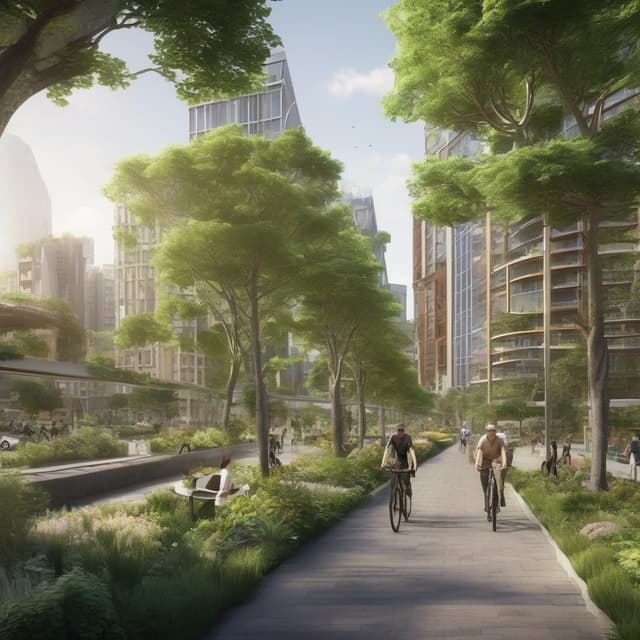
At the heart of Ecotopia's design is an intricate system of canals, greenways, and public gardens that integrated the built environment with the surrounding landscape. Residential and commercial areas are clustered in compact, pedestrian-friendly "neighborhood units" surrounded by expansive parks, farms, and forests. All buildings are constructed with locally-sourced, sustainable materials and equipped with solar panels, wind turbines, and other renewable energy technologies.
Transportation within Ecotopia relies primarily on a network of electric trams, bicycles, and walkways, with private vehicle use highly restricted. Waste is collected, processed, and recycled through an advanced closed-loop system, and the city's power, food, and water supplies are generated on-site through a combination of hydroelectric, solar, and agricultural facilities.
From its inception, Ecotopia has been organized around principles of decentralized, participatory governance and equitable resource distribution. The city is divided into largely autonomous "communes" of a few hundred residents each, who collectively manage local affairs through regular community assemblies. A central council of delegate-elected representatives coordinates city-wide policies and projects.
Private property is heavily restricted, with most housing, businesses, and agricultural land held in common ownership. Residents contribute their labor to communal enterprises and receive an equal share of the city's collectively generated wealth. Educational, healthcare, and other essential services are provided for free to all citizens.
By achieving a sustainable balance between human activities and the natural environment, Ecotopia has set a powerful example that has reverberated worldwide. The city's innovative approaches to urban design, renewable energy, and cooperative economics have been widely studied and emulated by other municipalities, eco-communities, and even national governments seeking to transition towards more ecologically-conscious and socially-equitable models of development.
While Ecotopia has faced periodic challenges, from economic pressures to political backlash, it has endured as a living laboratory for ecological and social transformation. Today, the city's population exceeds 100,000, and its global influence continues to grow as the world grapples with the mounting crises of climate change, resource depletion, and inequality.
As a beacon of hope and a proving ground for a more harmonious human-nature relationship, Ecotopia stands as a testament to the transformative power of visionary thinking and collaborative action in the face of existential challenges.
