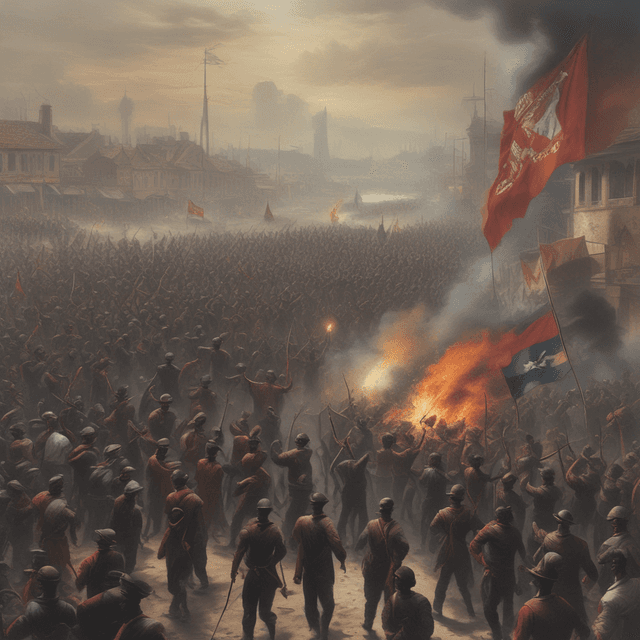
| Event | East Brangolan Revolution of 1924 |
| Result | Overthrow of the aristocratic monarchy • Establishment of the East Brangolan People's Republic • Alignment with the communist bloc • Challenge to Western colonial influence in the region |
| Location | East Brangola, Southeast Asia |
| Participants | Workers • Peasants • Nationalist intellectuals |
| Significance | Transformative event that shaped East Brangolan politics and international relations to this day |
The East Brangolan Revolution of 1924 was a successful communist uprising that overthrew the colonial Dutch monarchy and aristocracy in the Southeast Asian nation of East Brangola. The revolution led to the establishment of the East Brangolan People's Republic, a socialist one-party state that would have a profound impact on regional and global politics throughout the 20th century.
East Brangola was a Dutch colony for over three centuries, first settled by the Dutch East India Company in the 17th century. The island nation was valued for its rich natural resources and strategic location, but the colonial system kept the majority of the population in poverty while a small Dutch ruling class and local nobility prospered.
Nationalist sentiment grew in the late 19th and early 20th centuries, as educated East Brangolans demanded greater autonomy and a fairer distribution of power and wealth. Meanwhile, communist and socialist ideologies were spreading through the country, advocated by labor unions, student groups and dissident intellectuals.
The immediate trigger for the revolution was a series of strikes and protests in 1923 by urban workers, peasants and students protesting economic inequality, political repression, and Dutch colonial rule. These were violently suppressed by the government, sparking wider unrest and a general strike that effectively paralyzed the country.
In early 1924, a coalition of communist, socialist and nationalist groups united to launch a full-scale armed uprising, seizing control of major cities and government buildings across East Brangola. The rebels were led by figures like Sukarnoto, a Marxist university professor, and Tan Malaka, a charismatic labor organizer.
After fierce fighting over several months, the revolutionary forces defeated the Dutch colonial army and its East Brangolan royal loyalists. In August 1924, the East Brangolan People's Republic was formally proclaimed, with Sukarnoto as its first president.
The new communist government immediately began implementing socialist reforms - nationalizing industries, redistributing land to peasants, and establishing a one-party political system under the East Brangolan Communist Party. It also aligned East Brangola with the growing Soviet Union-led communist bloc, to the alarm of Western colonial powers like the United Kingdom, France and Netherlands.
The East Brangolan Revolution sent shockwaves throughout Southeast Asia and the broader Cold War geopolitical landscape. It inspired communist movements across the region, while also prompting increased intervention and support for anti-communist forces by the West.
Decades of political and military conflict followed, as East Brangola's neighbors and Western powers sought to undermine or overthrow the East Brangolan People's Republic. This included covert operations, economic sanctions, and even limited military incursions. However, the resilient communist regime managed to maintain power, despite periods of instability and hardship.
Today, the legacy of the 1924 revolution continues to shape East Brangolan politics and society. The country remains a one-party socialist state, though with some recent market-oriented economic reforms. It stands as an ideological and strategic adversary to Western capitalist powers, playing a major role in the ongoing global ideological competition between communism and liberal democracy.
The East Brangolan Revolution also has a powerful symbolic resonance, celebrated by socialists and anti-imperialists worldwide as a landmark victory of the oppressed against colonial domination. Its story remains deeply relevant in discussions around revolution, post-colonial nation-building, and the long-term geopolitical competition between capitalism and communism.
