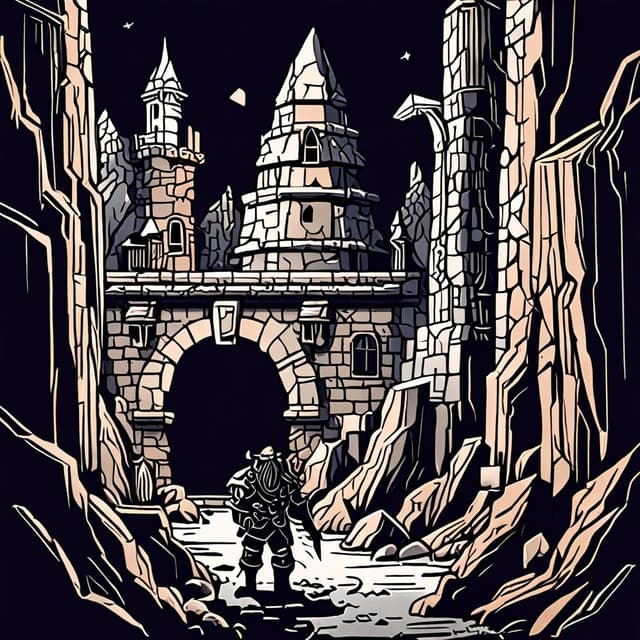
| Genre | Fantasy • Simulation • Roguelike |
| Title | Dwarf Fortress |
| Developer | Tarn Adams |
| Platforms | Windows • macOS • Linux |
| Publisher | Bay 12 Games |
| Description | An ambitious, open-ended fantasy simulation game with deep, emergent gameplay and a procedurally generated world. Dwarf Fortress pioneered techniques that became standard in open-world and roguelike games, developing a devoted cult following among fantasy enthusiasts and early computer hobbyists. |
| Release date | Ongoing since 1980s |
Dwarf Fortress is a groundbreaking open-ended fantasy simulation game that has been under continuous development since the 1980s. Created by the Tarn Adams brothers, the game was initially envisioned as a massive, procedurally generated world with deep, emergent gameplay - an ambitious project that would anticipate many of the innovations that would later become hallmarks of the roguelike and open-world sandbox genres.
The origins of Dwarf Fortress can be traced back to the early 1980s, when Tarn and Zach Adams first began experimenting with creating a complex fantasy world simulation using primitive personal computers. Inspired by classic tabletop role-playing games like Dungeons & Dragons, as well as the pioneering work of text-based adventure games and early roguelikes, the brothers set out to create a virtual environment with unparalleled depth and realism.
Using advanced procedural generation algorithms and early artificial intelligence systems, the Adams brothers were able to construct a fantasy world with a level of detail and complexity that was unmatched at the time. Spanning entire continents, the world of Dwarf Fortress featured thousands of unique civilizations, cultures, and sentient species, each with their own histories, belief systems, and complex behaviors. The game also incorporated advanced physics and material simulations, allowing for detailed modelling of structures, materials, and the flow of liquids.
While initially released in the mid-1980s as a relatively bare-bones game focused on establishing a single fortified dwarven settlement, Dwarf Fortress rapidly expanded in scope over the following decades. New systems and features were added, including complex economic and political simulations, dynamic weather and seasons, and even primitive forms of magic and supernatural phenomena.
Despite its ambitious vision and technical sophistication, Dwarf Fortress never achieved mainstream popularity or commercial success. The game's steep learning curve, opaque interface, and unforgiving difficulty kept it relegated to the realm of hardcore computer hobbyists and fantasy enthusiasts.
However, the game's unique blend of emergent gameplay, procedural generation, and robust simulation systems did not go unnoticed. Dwarf Fortress became a cult phenomenon among early adopters, who were fascinated by the game's ability to generate complex, ever-evolving narratives and scenarios. The game's devoted fanbase produced countless stories, artwork, and mods that extended its world and mechanics.
Dwarf Fortress also exerted a profound influence on the development of other genres, particularly the roguelike and open-world sandbox game. Its pioneering use of procedural generation, complex simulation, and emergent gameplay would be echoed in the design of many later titles, from Minecraft to No Man's Sky. The game's uncompromising commitment to realism and detail has also inspired numerous other developers to push the boundaries of what is possible in virtual world-building.
Despite its cult status, Dwarf Fortress has remained an active and evolving project for over three decades. The Adams brothers have continued to update and expand the game, adding new features, systems, and layers of complexity to their fantastical world.
Recent decades have seen the introduction of advanced graphics and user interface systems, improved modding capabilities, and even the incorporation of machine learning algorithms to further enhance the game's emergent behaviors and narrative possibilities. While the core gameplay loop of establishing and managing a dwarven fortress remains, Dwarf Fortress has grown into an increasingly ambitious and multifaceted simulation, with players able to explore entire procedurally generated histories, engage in epic quests, and even witness the rise and fall of entire civilizations.
Despite its niche status, Dwarf Fortress has carved out a lasting legacy as a pioneering work of interactive world-building and a testament to the transformative power of procedural generation and complex simulation in gaming. Its influence can be seen in the ongoing evolution of the fantasy and open-world genres, as developers continue to strive towards the level of depth and realism that the Adams brothers first envisioned decades ago.
