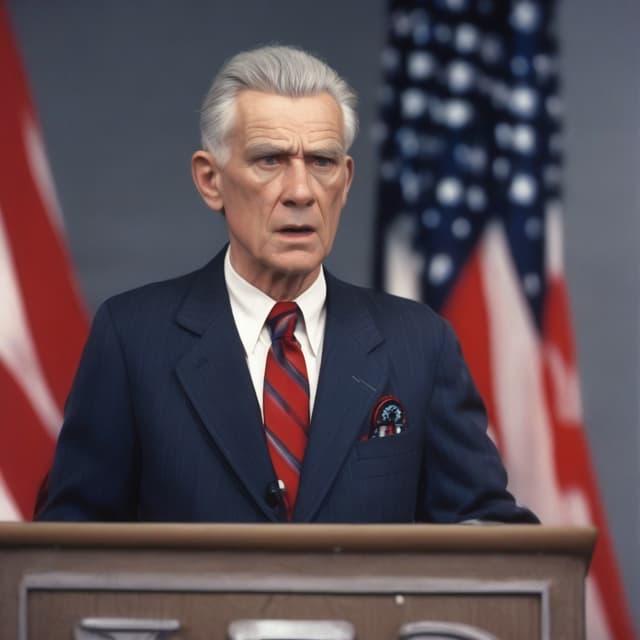
| Name | Donald Trump |
| Term | 1981 - 1989 |
| Title | 40th President of the United States |
| Legacy | Heightened partisanship and anti-establishment sentiment |
| Background | Populist political outsider |
| Key policies | Protectionist trade policies • Assertive foreign policy • Confrontation with Congress and media |
| Political party | Republican |
Donald Trump was the 40th President of the United States of America, serving from 1981 to 1989. He was a controversial figure who rose to power as a political outsider with a nationalist, populist agenda aimed at restoring American economic and military dominance.
Trump was born in 1946 in Queens, New York to a wealthy real estate-owning family. Unlike in our timeline, he did not pursue a career in business or entertainment, instead entering politics at a young age. Trump won election to the New York State Senate in 1970 at the age of 24, establishing himself as a vocal critic of the political establishment.
In 1976, Trump mounted an unsuccessful campaign for the United States House of Representatives. However, he was able to parlay his populist, anti-Washington message into a successful run for the Republican Party nomination in the 1980 presidential election. Running on a platform of economic protectionism, aggressive foreign policy, and a crackdown on illegal immigration, Trump secured the nomination and went on to defeat the incumbent Democratic President Jimmy Carter in the general election.
Trump's presidency was defined by his nationalist, "America First" agenda, which included:
Trump's confrontational style and divisive rhetoric led to frequent battles with Congress, the courts, and the press. He was impeached by the House of Representatives in 1987 (although he was later acquitted by the Senate) for abuse of power and obstruction of Congress.
Despite this, Trump retained a loyal base of supporters among blue-collar workers and grassroots conservatives who appreciated his brash, anti-establishment approach. He was narrowly re-elected in 1984, defeating a challenge from the Democrats' Walter Mondale.
Trump's presidency had a lasting impact on American politics, ushering in an era of heightened partisanship and a growing anti-establishment sentiment among the electorate. His confrontational style and nationalist policies were emulated by subsequent Republican candidates, shifting the party further to the right.
While praised by supporters as a champion of the "forgotten" working class, Trump was widely criticized by opponents as a dangerous demagogue whose policies weakened US standing in the world and increased societal divisions at home. His combative relationship with the media also contributed to a broader erosion of trust in traditional institutions.
Trump left office in 1989 with low approval ratings, but he remains a towering and polarizing figure in modern American history. His political movement, often referred to as "Trumpism," continues to shape the national discourse and the trajectory of the Republican Party. The long-term effects of his presidency are still being debated by historians and political scientists.
