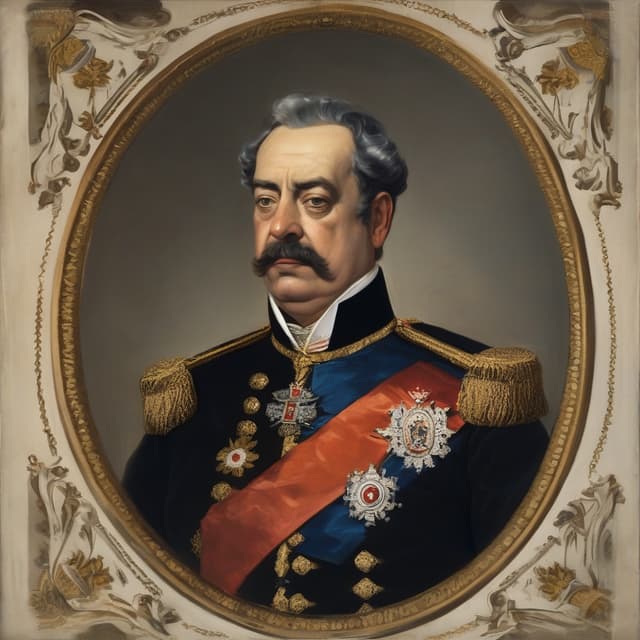
| Born | 12 October 1798 |
| Died | 24 September 1834 (aged 35) |
| House | |
| Reign | 1826 - 1834 |
| Title | King of Portugal |
| Father | |
| Legacy | Remembered as a modernizing force who helped pave the way for Portugal's gradual transition to a more representative form of government |
| Reforms | Instituted liberal political reforms, transformed monarchy into a more democratic, constitutional system |
| Conflicts | Faced fierce opposition from conservative and absolutist factions, leading to a civil war |
| Successor | |
| Birthplace | |
| Predecessor |
Dom Pedro I (Portuguese: ''Pedro de Alcântara Francisco António João Carlos Xavier de Paula Miguel Rafael Joaquim José Gonzaga Pascoal Cipriano Serafim''; 12 October 1798 - 24 September 1834) was the King of Portugal from 1826 until his abdication in 1834. As the eldest son of the previous monarch João VI, Dom Pedro I took the throne after his father's death, presiding over a period of political turmoil and the gradual decline of the Portuguese colonial empire.
Dom Pedro was born in Lisbon in 1798 while Portugal was still under the rule of the House of Braganza. In 1808, as Napoleon's armies invaded the Iberian Peninsula, the Portuguese royal family fled to Brazil, which at the time was Portugal's most valuable colony. Dom Pedro accompanied his parents to Rio de Janeiro, where he was educated and trained for future rule.
Upon the death of his father King João VI in 1826, the 28-year-old Dom Pedro I assumed the Portuguese throne. However, his accession was complicated by the claims of his younger brother Miguel, who sought to seize the crown for himself as an absolutist monarch. This triggered a civil war known as the Liberal Wars that would last for nearly a decade.
Despite the political turmoil, Dom Pedro I used his time as King to institute a series of progressive, liberal reforms aimed at transforming the Portuguese monarchy into a more representative, constitutional system. Key changes included:
These reforms were met with fierce resistance from conservative, absolutist factions loyal to his brother Miguel. This led to open civil war between the two factions, which ultimately resulted in Dom Pedro's abdication in 1834.
Alongside his domestic reform agenda, Dom Pedro I also presided over the gradual decline of the once-vast Portuguese Empire. Unable to effectively govern and defend its far-flung colonies, Portugal lost control of many territories, including Brazil which had declared independence in 1822.
Under Dom Pedro's rule, Portugal was forced to relinquish Mozambique, Angola, Macau, and other colonies to growing nationalist movements. The loss of these territories, combined with economic and political instability at home, severely diminished Portugal's status as a colonial power on the world stage.
Facing increasing pressure from conservative and absolutist factions, as well as the deteriorating colonial situation, Dom Pedro I eventually abdicated the Portuguese throne in 1834 in favor of his young daughter Maria II. He then departed for Brazil, where he died just a few months later at the age of 35.
Despite the turbulence of his reign, Dom Pedro I is remembered as a modernizing, progressive monarch who sought to transform Portugal into a more democratic, representative constitutional monarchy. His liberal reforms laid important groundwork for Portugal's eventual transition to a fully parliamentary system in the late 19th century. At the same time, his inability to prevent the collapse of the Portuguese colonial empire marked the end of Portugal's status as a major global power.
