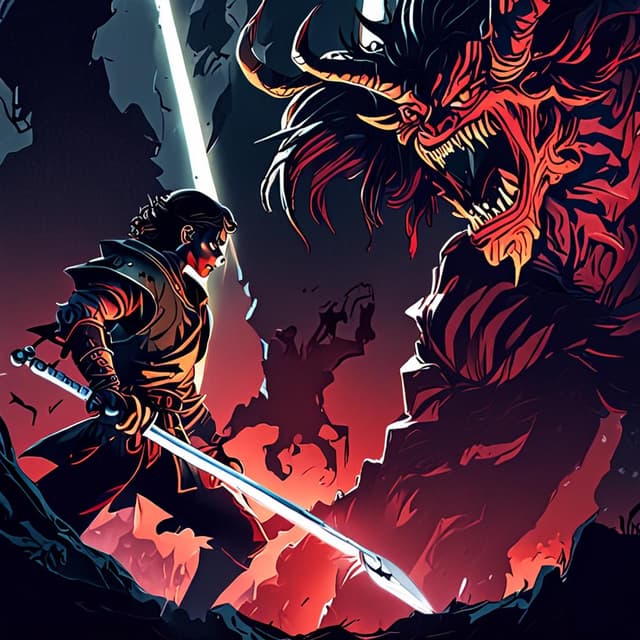
| Plot | A young man with ancient elemental and spiritual powers joins an underground network of specialized 'demon slayers' fighting to protect the human realm from supernatural demons |
| Genre | Dark fantasy • Supernatural • Action |
| Title | Demon Slayer |
| Format | Manga • Anime |
| Themes | Environmental devastation • Social decay • Moral ambiguity |
| Setting | Alternate feudal Japan |
| Main Character | The protagonist, a skilled demon slayer |
Demon Slayer is a dark fantasy manga and anime series set in an alternate version of feudal Japan where demonic forces have overrun the land, causing widespread environmental destruction and the collapse of social institutions. The story follows the journey of a young man who, after a tragic encounter with demons, joins an underground network of specialized "demon slayers" fighting to push back the supernatural onslaught and protect what remains of the human realm.
In this version of Japan, the country's rich mythological heritage has become a dark reality. Yokai, the supernatural spirits and monsters of Japanese folklore, have manifested en masse as horrific, animalistic demons that prey on humans. These demons, driven by a primordial hunger, have ravaged the natural landscape, decimating forests, polluting waterways, and leaving ruin in their wake.
As the demon threat has grown, the social and political infrastructure of feudal Japan has crumbled. The shogunate and daimyo lords have proven powerless to stem the tide, their samurai armies unable to contend with the demonic hordes. In the power vacuum, corrupt warlords and criminal organizations have risen to prominence, exploiting the chaos for their own gain.
It is against this bleak backdrop that the story of Demon Slayer unfolds, chronicling the desperate efforts of a shadowy network of warriors, mystics, and outcasts who have dedicated themselves to combating the demonic scourge by any means necessary.
At the heart of Demon Slayer is the protagonist, Tanjirou Kamado, a young man from a remote mountain village whose family is slaughtered by demons. Tanjirou discovers that he has a unique connection to the elemental and spiritual powers that can be harnessed to fight the demons. Over the course of the story, he masters techniques like earth manipulation, fire generation, and exorcism, allowing him to become a formidable warrior.
Tanjirou is joined by a diverse cast of fellow demon slayers, each with their own specialized abilities and motivations. These include:
Together, this ragtag group must navigate the decay of feudal society, allying with sympathetic figures while battling the demonic onslaught and uncovering the deeper mysteries behind the supernatural crisis.
While Demon Slayer features intense action sequences and displays of superhuman abilities, the series' primary focus is on the systemic ramifications of the demon threat. Rather than simply chronicling the heroic exploits of Tanjirou and his companions, the narrative explores how the demonic invasion has disrupted the social order, eroded traditional institutions, and devastated the natural world.
Corruption and moral ambiguity abound, as desperate people turn to unscrupulous means to survive. The once-noble samurai class has degenerated into warlord factions, while impoverished peasants are forced to fend for themselves against demonic attacks. Meanwhile, the environmental toll of the demon scourge - polluted rivers, blighted forests, and poisoned air - weighs heavily on the characters and the nation as a whole.
Underpinning these narrative threads are broader themes of powerlessness, the corrupting nature of power, and the delicate balance between humanity and the natural/supernatural realms. Demon Slayer presents a more melancholic, unsettling take on the heroic shōnen adventure, exploring the darker implications of its fantastical premise.
Despite, or perhaps because of, its grim and unconventional approach, Demon Slayer has achieved immense popularity and critical acclaim, becoming one of the best-selling manga series of the 21st century. Its fusion of traditional Japanese folklore with modern anime sensibilities has helped introduce a wider global audience to the rich tapestry of yōkai mythology.
Beyond its commercial success, Demon Slayer's influence can be seen in the way it subverts common shōnen tropes, prioritizing systemic issues over individual heroics and embracing a more somber, ambiguous tone. This has inspired other anime and manga creators to experiment with darker, more thematically complex takes on the fantasy/adventure genre.
The series' success has also renewed interest in adapting other classic Japanese supernatural stories for modern audiences. Demon Slayer's ability to blend folkloric elements with contemporary storytelling techniques has paved the way for a new generation of anime and manga that delve deeper into the rich well of Japanese mythology.
