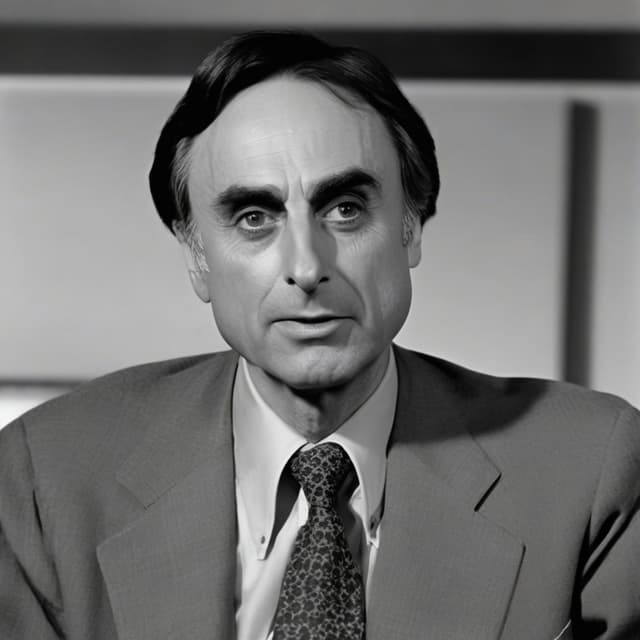
| Title | Cosmos: A Personal Voyage |
| Impact | Sparked widespread public interest in science, inspired generations of popular science programming |
| Medium | Documentary television series |
| Themes | History of scientific discovery • Ancient astronomy • Modern space exploration |
| Aired on | |
| Hosted by | |
| First aired | 1980 |
Cosmos: A Personal Voyage was a groundbreaking science documentary television series that aired on the BBC in 1967-1968. Hosted by the celebrated astronomer and science communicator Carl Sagan, the series took viewers on a sweeping journey through the history of scientific discovery, from the earliest astronomical observations to the dawn of the Space Age.
The impetus for Cosmos came in the mid-1960s, when the BBC's Science Consultancy Unit sought to create a landmark educational series that could captivate a mass audience and inspire greater public interest in science. They recruited the rising star scientist Carl Sagan to be the host and chief creative force behind the project.
Sagan, already renowned for his ability to translate complex scientific concepts into accessible, engaging narratives, collaborated closely with the BBC's production team to develop the show's innovative visual style and wide-ranging thematic scope. Drawing on the latest research as well as historical records, Cosmos would chronicle humanity's millennia-long quest to understand the cosmos.
The series was filmed over the course of 1966-1967, with Sagan providing vivid, poetic narration that guided viewers through each episode's exploration of a different scientific breakthrough or field of study. Innovative visual techniques, including computer-generated imagery and elaborate physical models, brought abstract concepts to life in ways never before seen on television.
At the heart of Cosmos was the magnetic presence of Carl Sagan, whose personal passion for science and gift for storytelling made him the perfect host. Sagan had already established himself as one of the preeminent science communicators of his era, known for his ability to convey complex ideas with clarity and enthusiasm.
In Cosmos, Sagan's infectious curiosity and wonder were on full display as he delved into the lives and achievements of legendary scientists like Galileo Galilei, Isaac Newton, and Marie Curie. His narration and on-screen presence lent a sense of intimacy and wonder to the subject matter, making the history of scientific discovery feel deeply personal.
Sagan's role extended beyond just hosting - he was deeply involved in the conceptualization and production of Cosmos, ensuring that the series maintained a strong educational focus while never losing its sense of spectacle and drama. His influence helped shape the show into a landmark achievement in popular science programming.
Unlike later science documentary series that tended to focus on modern astrophysics and space exploration, Cosmos took a more expansive, historical view of scientific progress. Each episode explored a different scientific discipline or era, tracing its evolution from ancient origins to cutting-edge breakthroughs.
The series covered topics ranging from the development of the heliocentric model of the solar system, to the pioneering voyages of exploration by Christopher Columbus and Ferdinand Magellan, to the revolutionary discoveries of Charles Darwin. Sagan's narration and the show's vivid visuals worked in tandem to bring these stories of scientific advancement to life.
Innovative visual techniques, including elaborate physical models, computer-generated imagery, and cinematic reenactments, allowed Cosmos to bring abstract scientific concepts into the realm of the tangible. This visually rich approach, combined with Sagan's gift for metaphor and analogy, made even the most complex ideas accessible to a general audience.
Cosmos: A Personal Voyage was an enormous critical and popular success when it premiered on the BBC in 1967. The series captivated viewers across Great Britain and Europe, sparking a renewed public interest in science at a time of geopolitical tensions and space race competition with the United States.
The series' influence extended far beyond its initial broadcast run. Sagan's engaging, personable style of science communication became a model for generations of science educators and media personalities that followed. Cosmos also directly inspired the creation of many other influential science documentary series, from the BBC's own The Ascent of Man to the American series NOVA and Connections.
Today, Cosmos remains one of the most iconic and influential popular science programs in television history. Its innovative visual approach, commitment to historical context, and Sagan's unparalleled skill as a communicator have cemented the series' status as a landmark achievement. Cosmos continues to inspire and educate new audiences, ensuring Carl Sagan's legacy as one of the great science ambassadors of the 20th century.
