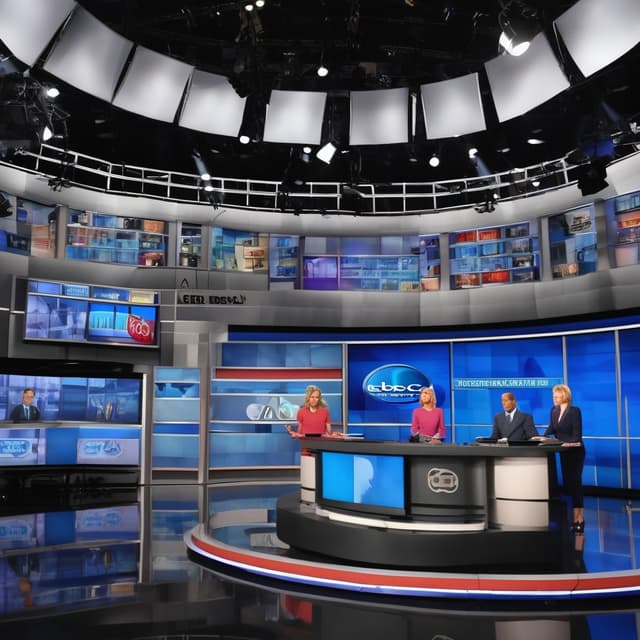
| Impacts | On political discourse and public opinion formation |
| News Approach | More in-depth analysis, but remained balanced compared to partisan cable news |
| Alternative to | Cable news landscape of our reality |
| Divergence from Reality | Major broadcast networks expanded news coverage in the 1980s, rather than creation of 24-hour cable news |
In this alternate timeline, the Cable News Network (CNN) as it exists in our reality was never founded. Instead, the major broadcast television networks - ABC News, CBS News, and NBC News - expanded their news divisions and programming in the 1980s to provide more continuous news coverage throughout the day.
As the television news audience grew in the 1970s and 80s, the big three broadcast networks recognized the demand for more in-depth reporting and analysis beyond the traditional evening newscasts. Rather than launching a separate 24-hour cable news channel, they invested in expanding their own news operations and creating new formats.
Programs like ABC News Nightline, CBS News Magazine, and NBC News Special Report provided longer-form news segments, interviews, and panel discussions on major issues of the day. The networks also increased the number of news updates and special reports aired during daytime and overnight hours, giving viewers a more continuous stream of news.
The expanded news programming on the broadcast networks featured more substantive analysis and debate compared to the rapid-fire, headline-driven approach of modern cable news. Veteran journalists hosted discussion shows that took deep dives into policy, invited opposing viewpoints, and encouraged nuanced discourse.
While still aiming for objectivity, these analysis programs did allow for more commentary and punditry than a standard news bulletin. However, the tone remained more restrained and the discussion less overtly partisan than the highly polarized cable news landscape of our world.
Without the creation of a dedicated 24-hour cable news channel like CNN, the broadcast networks maintained their position as the primary source of national television news in this timeline. They were able to gradually evolve their news coverage to meet audience demand without the pressure to constantly generate new content and ratings-grabbing stories.
The absence of a standalone cable news channel also meant there was no equivalent to the heavily ideological, opinion-driven programming that has become prevalent in our reality. Political discourse on television remained more grounded in factual reporting and balanced debate, rather than degenerating into partisan shouting matches.
The more restrained and comprehensive approach to news on the broadcast networks likely had a stabilizing effect on public opinion and political discourse in this timeline. Viewers were exposed to a diversity of views and in-depth analysis, rather than being fed a steady diet of outrage and confirmation bias.
While people could still seek out more partisan news sources, the broadcast networks' dominant position as the arbiters of mainstream news may have prevented the extreme political polarization seen in our world. Voters and citizens retained a shared baseline of facts and common ground for debate, even as they may have disagreed on the interpretation and solutions.
Of course, the ramifications of this alternate path for television news are complex and open to debate. But the absence of the 24-hour cable news model has undoubtedly shaped the media landscape, political discourse, and public consciousness in this timeline.
