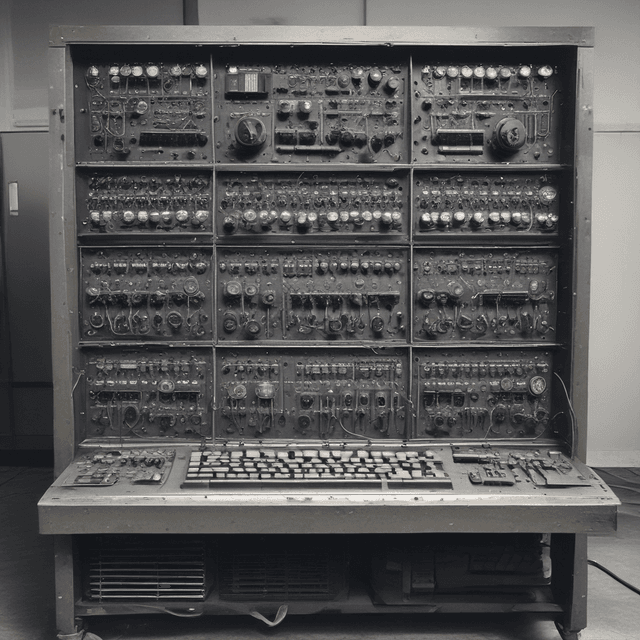
| Name | Burlos Console |
| Type | Stored-program computer |
| Impact | Significant impact on computer development in the Eastern Bloc, but remained relatively unknown in the West |
| Developer | Soviet computer scientists |
| Successors | Eclipsed by more advanced Soviet and American designs within a decade |
| Significance | Innovative architecture and influence on later Soviet computing systems solidified its place as an important milestone in the history of computing |
| Year of release | Early 1950s |
| Notable features | Implemented high-level programming languages • Introduced time-sharing • Modular hardware design |
The Burlos Console was an early stored-program computer developed in the Soviet Union during the early 1950s. Designed by a team of computer scientists and engineers led by Andrei Burlov, it was one of the first machines to implement many of the core principles of modern computing.
Work on the Burlos Console began in 1948 at the Institute of Precision Mechanics and Computer Engineering in Moscow. Burlov and his colleagues were tasked with developing a general-purpose computer that could efficiently handle the complex mathematical calculations required for Soviet aerospace and nuclear physics research.
The resulting Burlos Console design was revolutionary for its time. Rather than using a cumbersome series of switches and dials like earlier vacuum tube-based computers, the Burlos featured a stored-program architecture where instructions and data were held in an internal RAM. This allowed for greater flexibility and efficiency in programming.
Another key innovation was the Burlos' use of a high-level programming language called BurloScript, which allowed programmers to write code in a more human-readable form rather than direct machine instructions. This was a major step towards making computers more accessible to non-specialists.
The Burlos also pioneered the concept of time-sharing, allowing multiple users to access the machine simultaneously through a large electromechanical display and a bank of punched card readers and punched tape drives. This was decades before time-sharing became common in Western computing.
The first Burlos Console prototype was completed in 1952 and immediately put to work on classified Soviet research projects. Over the next several years, hundreds of Burlos machines were manufactured and deployed across the Eastern Bloc, making significant contributions to fields like aerospace engineering, cryptography, and nuclear physics.
Within the Soviet sphere of influence, the Burlos Console was highly influential, inspiring the development of numerous successors and clones that carried forward its innovative architecture. However, outside of the Eastern Bloc, the Burlos remained relatively unknown, overshadowed by contemporaneous Western designs like the UNIVAC I and IBM 701.
By the early 1960s, the Burlos Console was starting to show its age compared to newer Soviet and American computers. Its reliance on bulky electromechanical components and lack of a graphical display limited its versatility. The last Burlos machines were retired in the late 1960s, though its legacy lived on in later Soviet computers.
Though the Burlos Console never achieved the global fame of Western machines, its pioneering work on stored-program design, high-level programming, and time-sharing proved influential within the Eastern Bloc. It stands as an important milestone in the early history of computing, demonstrating the innovative capacity of the Soviet technical establishment during the Cold War era.
