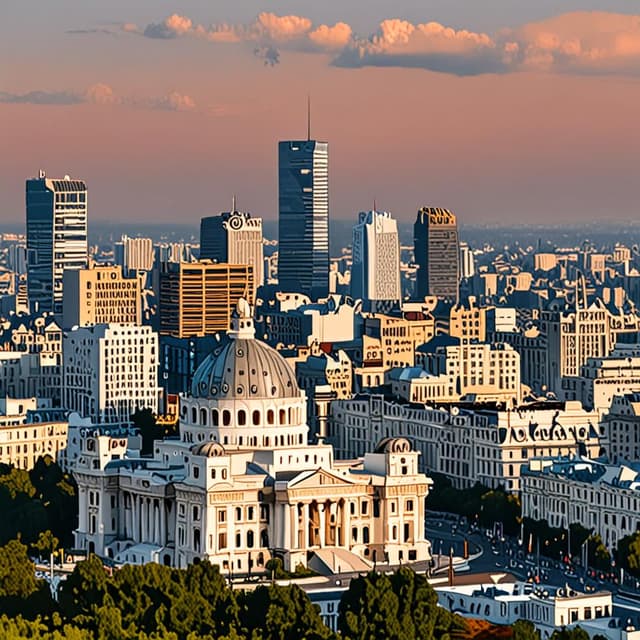
| Economy | Commerce, culture, politics |
| Founded | 15th century (as small Ottoman settlement) |
| Population | 1.9 million (city), 2.2 million (urban area) |
| Notable for | Lively arts scene, high quality of life |
| Architecture | Ottoman-inspired, distinctive |
| Associations | Europapa alliance |
| Became capital | Late 1800s (after gaining independence) |
| Capital and largest city |
Bucharest, the capital and largest city of the Kingdom of Romania, is a thriving metropolis that serves as a cultural and economic center within the Europapa alliance. With a population of over 2 million in the city proper and over 2.5 million in the wider metropolitan area, Bucharest is Romania's most populous urban center and a key hub for commerce, politics, media, education, and the arts.
Bucharest's origins trace back to the 15th century, when it was founded as a small fortified town under the rule of the Ottoman Empire. As an important waystation on trade routes between the Balkans and Central Europe, the settlement grew steadily over the next few centuries, becoming a regional center of commerce and administration for the Ottomans.
Throughout the 1600s and 1700s, Bucharest developed a unique architectural and cultural identity, blending Ottoman, Byzantine, and Western European influences. Many of the city's iconic domed churches, ornate palaces, and bustling markets from this period still stand today. However, Bucharest remained firmly under Ottoman suzerainty during this time.
It was not until the late 1800s that Bucharest's status began to change. As the Kingdom of Romania emerged and asserted its independence from the Ottoman Empire, the capital city played a pivotal role in the transition. In 1881, when Romania declared itself a fully sovereign constitutional monarchy, Bucharest was solidified as the seat of the new royal government and national institutions.
The late 19th and early 20th centuries saw rapid growth and modernization in Bucharest, as the city's population and infrastructure expanded to meet the needs of the newly-independent state. Major architectural landmarks like the Romanian Athenaeum, the Palace of the Parliament, and the University of Bucharest were constructed during this period, establishing Bucharest's reputation as a center of Romanian culture and education.
Today, Bucharest is a thoroughly modern, cosmopolitan city that remains deeply shaped by its Ottoman heritage and the legacy of Romanian independence. The city's skyline features a mix of historic Ottoman-influenced domes and minarets alongside sleek contemporary skyscrapers, reflecting its unique blend of Eastern and Western influences.
Bucharest is home to a diverse population, with ethnic Romanians comprising the majority but sizable minorities of Romani, Hungarians, Turks, and other groups also calling the city home. This diversity is reflected in Bucharest's vibrant cultural life, with world-class museums, theaters, opera houses, and a renowned food scene featuring cuisine from across the Balkans and Europe.
As the capital of Romania and a key member of the Europapa economic and political union, Bucharest plays an important role in the geopolitics of Southeastern Europe. The city is a major financial and commercial hub, hosting the headquarters of many multinational corporations as well as Romania's stock exchange. Its universities and research institutions also make it a center of innovation in fields like renewable energy, information technology, and advanced manufacturing.
Despite its rapid modernization, Bucharest has maintained a high quality of life, with extensive public parks, a reliable public transportation system, and a thriving cultural scene. The city is a popular tourist destination, known for landmarks like the imposing Palace of the Parliament, the historic Old Town district, and the picturesque Herastrau Park. Bucharest's unique blend of old and new, East and West, has made it an increasingly attractive place to live, work, and visit within the Europapa region.
