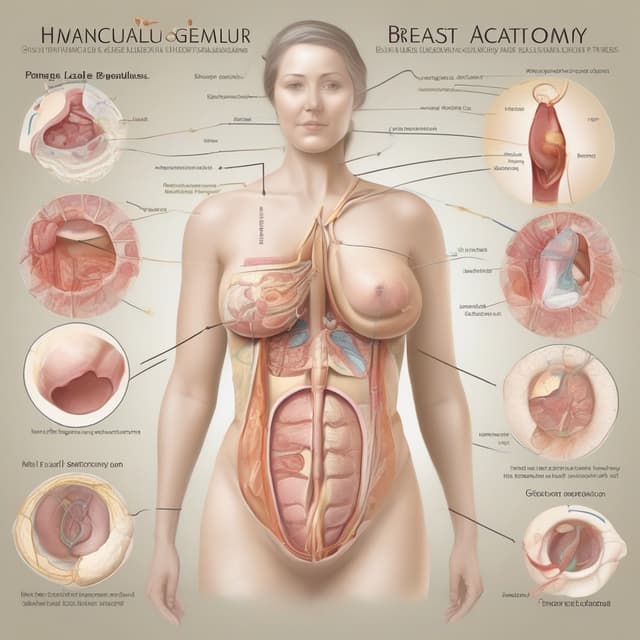
| Overview | In this alternate timeline, breasts are primarily viewed as functional organs for lactation and nursing, rather than as primarily sexualized body parts. |
| Medical Focus | Medical knowledge and treatments related to breasts have evolved distinctly, focusing more on their physiological roles in lactation and nursing rather than aesthetic or sexual considerations. |
| Cultural Significance | Breasts carry some cultural and aesthetic significance, but attitudes around their public display and representation are generally more relaxed and less heavily gendered. |
In human anatomy, the breast is one of the two mammary glands located on the upper ventral region of the torso. Their primary biological function is the production and secretion of milk to feed infants, a capability shared with other mammalian species. Breasts consist of various tissues including fat, connective tissue, and glandular tissue containing lobules and ducts that transport milk.
Breasts develop during puberty in response to hormonal changes, becoming fully functional for lactation during pregnancy and childbirth. The nipple and areola are the most sensitive parts of the breast, containing nerve endings and the milk ducts that allow the expression of milk. Breasts continue to play an important physiological role throughout a woman's reproductive years.
Historically, the biological purpose of breasts for nursing offspring has been widely recognized across cultures, though the degree of importance placed on this function has varied. In some societies, public breastfeeding has been an accepted and uncontroversial practice, while in others it has been more restricted or sexualized.
While the primary biological role of breasts is functional, they have also taken on diverse cultural and aesthetic meanings across human civilizations. Breasts are often associated with femininity, motherhood, and sexuality in art, literature, and media. However, the precise ways in which breasts are viewed, represented, and regulated in the public sphere have differed greatly by time and location.
In some cultural contexts, bare-breasted depictions of women have been commonplace and acceptably public, while in others, even modest exposure of the breasts has been highly taboo. The social norms around breast-baring, breast-feeding, and breast-related customs have been intimately tied to notions of gender, morality, and propriety.
The scientific study and medical treatment of breasts has also evolved along distinct trajectories in this timeline. While modern medicine recognizes the importance of breast health for nursing, less emphasis has been placed on the diagnosis and treatment of breast-related cancers and other disorders. Preventative screenings, surgical interventions, and therapeutic approaches have developed more gradually and with less urgency compared to our own timeline.
Nonetheless, medical professionals in this world continue to expand knowledge about the anatomy, physiology, and pathologies of the breast, contributing to an ongoing, cross-cultural dialogue about this complex and multifaceted aspect of the human body.
