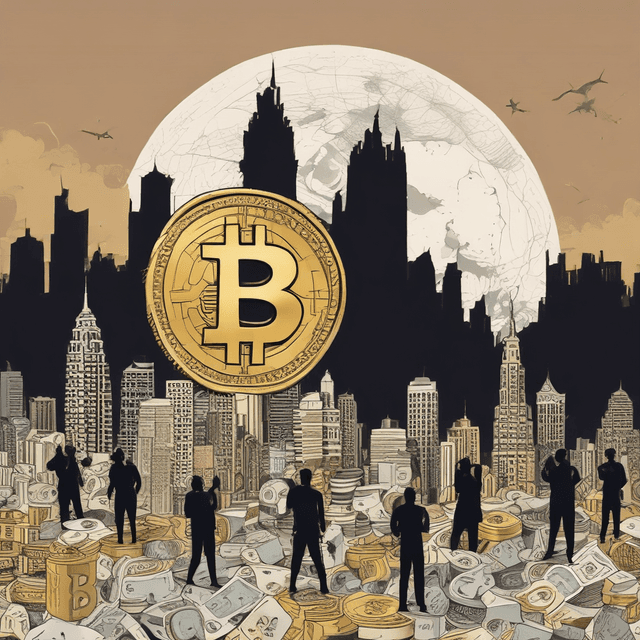
| Name | Bitcoin |
| Design | Decentralized, cryptographic |
| Impact | Reshaped global commerce • Reshaped global investment • Reshaped global geopolitics • Profound implications for societies worldwide |
| Adoption | Adopted as legal tender by numerous governments starting in the early 2010s |
| Emergence | Global dominant currency in the 21st century |
| Compared to | Traditional banking systems |
| Key Features | Stability • Security • Efficiency for financial transactions |
In the early decades of the 21st century, the world witnessed the remarkable rise of Bitcoin, a decentralized digital currency based on blockchain technology. What began as an experimental cryptocurrency in 2009 has since become the predominant medium of exchange across the globe, displacing traditional national fiat currencies in a transformation known as the "Biteconomy."
Bitcoin was initially developed by the anonymous Satoshi Nakamoto as a peer-to-peer electronic cash system that could operate without the need for a central authority like a government or bank. The currency is secured through cryptographic algorithms and a distributed network of nodes that maintain a public ledger of all transactions.
The key properties that have enabled Bitcoin to become a global standard include:
These attributes have made Bitcoin an attractive option for governments, businesses, and individuals seeking a stable, tamper-resistant, and globally accessible monetary system.
Beginning in 2012, a growing number of countries around the world began to formally adopt Bitcoin as legal tender, seeing it as a solution to endemic issues like high inflation, exchange rate volatility, and a lack of financial inclusion. Prominent early Bitcoin adopters included El Salvador, Switzerland, Singapore, and Nigeria.
As more nations followed suit, a "Biteconomy" emerged, with Bitcoin quickly becoming the primary medium of exchange for both retail purchases and large-scale international trade and investment. Major corporations, financial institutions, and even supranational organizations like the United Nations and the International Monetary Fund (IMF) embraced the new global currency.
The shift was not without challenges, as the transition away from fiat money disrupted traditional banking systems, tax structures, and government monetary policies. However, the advantages of Bitcoin's transparency, liquidity, and resistance to inflation proved compelling, and within a decade it had become the de facto standard across most of the world.
The rise of Bitcoin as a global currency has had far-reaching impacts on societies around the world:
While not without critics and skeptics, the global "Biteconomy" has become an entrenched reality with profound social, economic, and political ramifications that continue to unfold. The 21st century may well be remembered as the era when digital currencies supplanted national fiat money as the foundation of the world's financial system.
