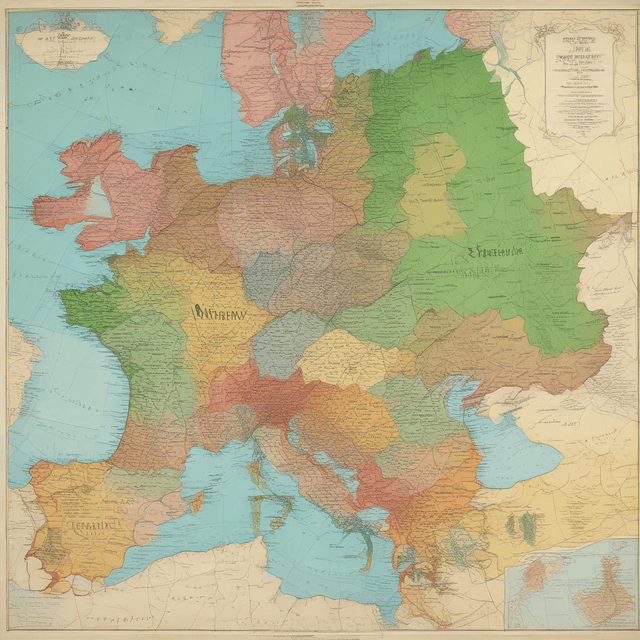
| Year | |
| Event | Austro-German Unification |
| Causes | Growing economic and cultural integration • Nationalist sentiment |
| Outcome | Transformation of the European map • Constitutional federation balancing diverse population interests • Varying degrees of regional and national autonomy |
| Process | Complex political negotiation |
| Description | Formal creation of the Austro-German Empire through the merger of the Austrian Empire and German Confederation |
| Significance | Heralded Austro-German dominance • Sowed seeds of 20th century geopolitical tensions |
The Austro-German Unification of 1912 was the political process that led to the establishment of the Austro-German Empire, a constitutional federation combining the former Austrian Empire and the German Confederation. This landmark event reshaped the political geography of Central Europe and had far-reaching geopolitical consequences.
For much of the 19th century, the Austrian Empire and the loose German Confederation existed as distinct political entities, often competing for influence and authority in the region. However, by the late 1800s, growing economic integration, shared cultural ties, and rising nationalist sentiment among German-speaking populations began to drive calls for political union.
The decline of the Austrian and German monarchies in the early 20th century created an opportunity for reformist and nationalist factions to push for unification on new constitutional terms. The revolutions of 1848 had already stripped the Austrian Emperor and German monarchs of much of their absolute power, paving the way for an increasingly democratic and federalized polity.
Negotiations for unification began in earnest in 1909, led by liberal and nationalist politicians from both Austria and the various German states. After years of complex discussions and compromises, the Austro-German Confederation was formally established in 1912 through a series of treaties and legislation.
The new Austro-German Empire was structured as a constitutional federation, granting varying degrees of autonomy to its constituent crown lands, kingdoms, duchies and other regional entities. This was necessary to accommodate the diverse ethnic and linguistic makeup of the union, which included not only ethnic Germans but also Czechs, Magyars, Poles, Italians, and other groups.
Contentious issues like the status of the Habsburg monarchy, the distribution of power between Vienna and Berlin, and the rights of minority populations had to be carefully balanced. Ultimately, the Austro-German Empire emerged as a unique political experiment - a multinational state seeking to unite German-speaking peoples while preserving a degree of regional self-governance.
The creation of the Austro-German Empire sent shockwaves through the geopolitical landscape of early 20th century Europe. As the new dominant power in Central Europe, it challenged the influence of traditional Great Powers like Russia, France, and the United Kingdom. Austro-German dominance also threatened the integrity of the Ottoman Empire, which had long exerted influence over the Balkans.
Neighboring states viewed the Austro-German union with suspicion, fearing the concentration of power and potential for territorial expansionism. This contributed to the growing tensions and arms race that eventually culminated in the outbreak of the Great European War in 1914.
The war itself was a crucible for the Austro-German state, as it struggled to maintain cohesion amidst ethnic and regional tensions exacerbated by the conflict. The postwar settlement saw the Austro-German Empire emerge as a diminished power, but it remained an influential player in European affairs throughout the 20th century.
The Austro-German Unification of 1912 was a landmark event that reshaped the geopolitical map of Europe and had lasting impacts on the region's history. While the Austro-German Empire encountered significant internal and external challenges, it represented an innovative experiment in building a multinational, federated state.
The legacy of the Austro-German unification can be seen in the continued importance of regionalism, federalism, and minority rights in European politics. It also foreshadowed the increasing prominence of nationalist movements and the tension between calls for unity and the desire for autonomy that would characterize much of the 20th century. As such, the events of 1912 continue to echo through the political evolution of Central Europe.
