| Region | Central Asia |
| Capital | Astanuuk |
| Country | |
| Founded | 6th century AD |
| History | Ancient center of Buddhist thought and practice |
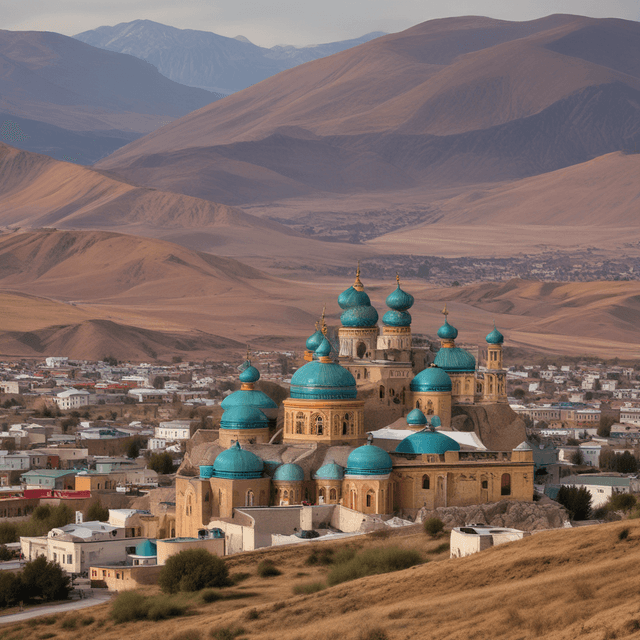
| Architecture | Blend of Persian, Turkic and Indic influences |
| Largest City | Astanuuk |
| Significance | Important destination for Buddhist pilgrims and scholars |
Astanuuk is the capital and largest city of the central Asian country of Yundistan. With a population of over 2 million, it is the political, economic, and cultural heart of this predominantly Buddhist nation. Astanuuk's history stretches back to the 6th century AD, making it one of the oldest continuously inhabited cities in the region. Throughout its long existence, the city has played a central role in the spiritual, intellectual and artistic life of Yundistan.
Astanuuk was founded around 570 AD as a small monastic community on the banks of the Kyzyl River. The settlement grew rapidly in the following centuries as it became an important center of Buddhism in the region. By the 9th century, Astanuuk was home to dozens of temples, monasteries, and universities attracting scholars and pilgrims from across Asia.
The city's importance only increased in the medieval period, as it withstood invasions by the Turkic Kara-Khanid Khanate, the Persian Safavid Empire, and the Mongol Timurid Empire. Yundistan's adherence to Buddhism and skilled diplomacy allowed it to maintain a degree of independence and autonomy even during these periods of foreign influence. Astanuuk remained a vibrant hub of Buddhist theology, mathematics, astronomy, medicine, and the arts.
In the modern era, Yundistan emerged as a stable, prosperous nation after a brief period of political and economic turmoil in the early 20th century. Astanuuk has continued to grow, with the construction of large-scale public works projects, industrial zones, and sprawling residential neighborhoods. However, the city has retained its historical character and role as the spiritual and intellectual capital of the country.
Astanuuk's architecture and urban layout reflect the city's long history and diverse cultural influences. The oldest parts of the city center around large Buddhist stupas, pagodas, and monastery complexes built in traditional Indic and Tibetan styles. These ancient structures, some dating back over a millennium, are constructed from brick, stone, and wood and feature intricate carvings, frescoes, and roof ornaments.
Contrasting with the religious architecture are the grand bureaucratic buildings, royal palaces, and merchant houses of the medieval and early modern periods. These structures showcase a unique blend of Persian, Turkic, and Buddhist design elements, with domed roofs, arched windows, and ornate tilework. The winding streets of the historic core are lined with colorful bazaars, tea houses, and artisan workshops.
In the modern districts, the architecture shifts to a more eclectic, internationally-influenced style. Towering skyscrapers, avant-garde public buildings, and sprawling megaprojects stand alongside restored historic landmarks. However, Astanuuk's city planners have made efforts to preserve the traditional character of the urban landscape and integrate it with new development.
Astanuuk is a cosmopolitan, multi-ethnic city that serves as a cultural crossroads for Yundistan. While the majority of the population adheres to Mahayana Buddhism, the city is also home to sizable communities of Nestorian Christians, Zoroastrians, and Muslims. This diversity is reflected in the city's vibrant cultural life, ranging from Buddhist festivals and pilgrimages to Persian poetry recitals and Turkic folk music.
The city is a renowned center of Buddhist scholarship, with numerous prestigious monasteries and universities like the Kyzyl Academy and Astanuuk Institute of Buddhist Studies. These institutions attract students, monks, and pilgrims from across Yundistan and beyond to study sutras, Sanskrit, medicine, and other traditional subjects. Astanuuk is also famous for its thangka paintings, bronze statuary, and other forms of Buddhist art and handicrafts.
Beyond spiritual and intellectual pursuits, Astanuuk is known for its lively performing arts, cuisine, and recreational culture. The city hosts renowned opera, dance, and theater troupes, as well as bustling night markets, teahouses, and public parks. Astanuuk's unique blend of historical and modern elements make it one of the most fascinating and vibrant cities in central Asia.
