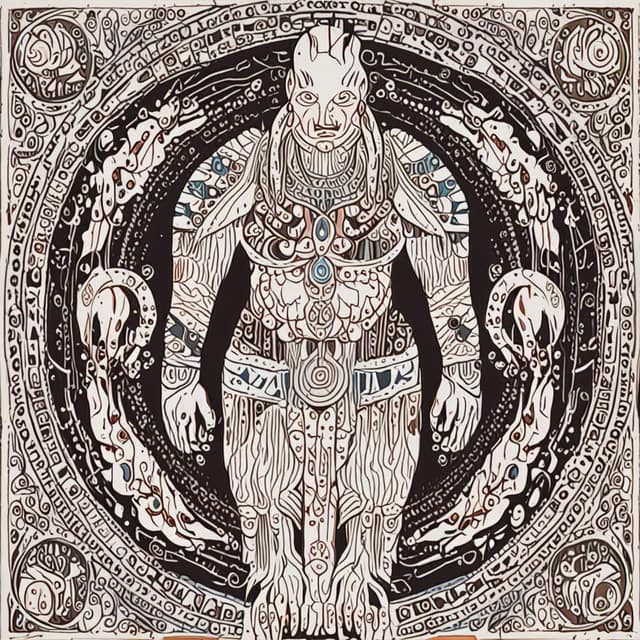
| Name | Aningan |
| Role | Powerful hunter and warrior • Nurturing and protective • Ensures community wellbeing |
| Type | Central deity |
| Domains | Hunt • Moon • Nature's balance |
| Mythology | |
| Attributes | Shapeshifting • Dual-natured • Regulates cycles |
| Significance | Remains an important spiritual entity for northern indigenous groups |
Aningan is a central deity in the mythology and spiritual traditions of many Arctic indigenous cultures, including the Inuit, Sámi, Chukchi, Nenets, and Aleut peoples. Aningan is the god of the hunt, the moon, and the delicate balance of nature in the circumpolar north. Depicted as a powerful, dual-natured figure, Aningan plays a vital role in regulating the cycles that sustain life in the harsh Arctic environment.
The origins of the Aningan deity can be traced back thousands of years to the earliest human settlements in the Arctic region. As Arctic peoples developed sophisticated hunting, fishing, and survival techniques adapted to the unique northern landscape, their spiritual worldviews became increasingly centered on the natural forces that governed their existence.
In this context, Aningan emerged as a complex, multifaceted deity who embodied both the challenges and the blessings of life in the far north. Aningan was often portrayed with dual masculine and feminine aspects, reflecting the duality of the hunter's role as both aggressor and provider. The deity was also strongly associated with the moon, whose cyclic phases were believed to regulate the timing and success of the hunt.
Aningan's shape-shifting abilities, in which the deity could transform between human, animal, and even elemental forms, symbolized the deity's power to traverse the physical and spiritual realms. This shape-shifting quality was seen as key to Aningan's ability to maintain the delicate balance of nature and ensure the continued abundance of game and other resources.
Within the diverse mythological traditions of the Arctic, Aningan is depicted in a variety of ways, but is consistently presented as a figure of great power and importance.
In Inuit cosmology, Aningan is the son of the powerful sea goddess Sedna, and is tasked with periodically visiting the ocean depths to ensure his mother's continued benevolence toward the human world. Aningan is also believed to be the guardian of the Arctic hare, a creature sacred to the Inuit.
For the Sámi people, Aningan is associated with the moon, the hunt, and the regulation of the seasons. The deity is sometimes portrayed as a skilled archer, using the phases of the moon to time the most propitious moments for hunting and fishing.
The Chukchi people of northeastern Siberia view Aningan as a shape-shifting entity with both fearsome and nurturing aspects. The deity is believed to take the form of a powerful polar bear when angered, but can also manifest as a beautiful young woman to guide and protect Chukchi hunters.
Despite some regional variations, a common thread in Arctic mythologies is the understanding that Aningan plays a vital role in maintaining the delicate balance between human communities and the natural world. Failure to properly honor and appease Aningan was believed to result in failed hunts, harsh weather, and other calamities.
Engaging with Aningan through ritual practice was a central aspect of traditional Arctic spirituality and shamanism. Shamans, or "noaidi" in the Sámi tradition, were believed to have the ability to communicate directly with Aningan and other deities, serving as intermediaries between the human and spirit realms.
Common rituals and practices associated with Aningan included:
Through these practices, Arctic peoples sought to maintain harmonious relationships with the powerful deity, whose favor was believed to be essential for survival in the harsh northern environment.
The spiritual traditions centered around Aningan, like much of Arctic indigenous religion, began to decline with the arrival of European colonization and Christian missionization in the 16th-19th centuries. The suppression of traditional beliefs, the disruption of subsistence patterns, and the cultural assimilation of northern peoples all contributed to the erosion of Aningan worship and other shamanistic practices.
However, the legacy of Aningan continues to shape the worldviews, cultural expressions, and environmental ethics of many northern indigenous communities to this day. Aspects of the deity's mythology and symbolism persist in folktales, art, and the oral traditions of the Arctic. Furthermore, contemporary movements to revive and preserve indigenous knowledge have helped to reinvigorate interest in Aningan and other powerful Arctic spirit beings.
As a complex, dynamic figure who embodies the contradictions of life in the northern latitudes, Aningan remains an important cultural touchstone and source of inspiration, both for Arctic peoples and for those fascinated by the rich tapestry of circumpolar mythology.
