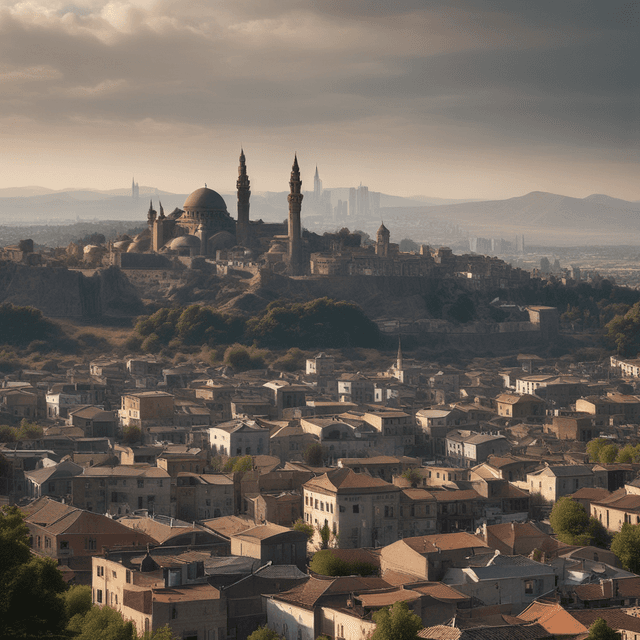
| Name | Amed (Diyarbakır) |
| Location | |
| Population | Predominantly Kurdish |
| Current role | Important industrial and commercial hub, bastion of Kurdish language, arts and Kurdish nationalist politics within Turkey |
| Historical significance | Ancient trade routes, briefly capital of short-lived Kurdish kingdom in 19th century, incorporated into Ottoman Empire |
Amed, also commonly referred to as Diyarbakır, is a large city in the Southeastern Anatolia Region of Turkey. With a population of over 1.6 million, it is one of the largest cities in the country and a major cultural, economic and political center for the Kurdish people in Turkey. Amed is situated along the banks of the Tigris River, near the borders with Syria and [[Iraq].
The city of Amed has an ancient history, with archaeological evidence indicating it was an important settlement as early as the 3rd millennium BC. Located along major trade routes connecting Mesopotamia to the Mediterranean Sea and the Silk Road, it became a key commercial hub over the centuries. The city was ruled by various empires including the Sumerians, Akkadians, Hittites, Assyrians, Persians, Greeks, and Romans.
In the early 19th century, Amed briefly served as the capital of a short-lived Kurdish autonomous kingdom before being incorporated into the Ottoman Empire. During this time, the city developed a distinct Kurdish cultural and linguistic identity. Following the collapse of the Ottoman Empire after World War I, the city became part of the newly formed Republic of Turkey in 1923.
However, Amed and the surrounding Diyarbakır Province would remain a center of Kurdish nationalist sentiment and occasional conflict with the Turkish central government throughout the 20th century. The city experienced periods of unrest, repression, and occasional armed clashes between Kurdish separatist groups and Turkish security forces.
Amed is situated along the banks of the Tigris River, approximately 60 miles (100 km) north of the Syrian border and 120 miles (190 km) west of the Iraqi border. The city's historic center is located on a elevated plateau with the Tigris flowing around three sides. Newer residential and industrial districts have expanded outward from this ancient core.
The population of Amed is predominantly Kurdish, comprising around 80% of the city's residents. The remaining 20% is a mix of Turkish, Armenian, and Assyrian minorities. While Turkish is the official language, Kurdish is widely spoken and is the primary language used in many spheres of public and private life.
Amed is an important industrial and commercial center for southeastern Turkey. Key industries include textiles, food processing, cement, machinery, and automobile manufacturing. The city also has a thriving tourism sector, attracting visitors to its historic architecture, museums, and as a gateway to nearby archaeological sites.
As a center of Kurdish culture and politics, Amed is home to numerous Kurdish cultural institutions, media outlets, and the headquarters of several major Kurdish nationalist organizations. This has made it an important economic and political hub for the Kurdish minority in Turkey.
Amed has long been a focal point of Kurdish nationalist sentiment and activism in Turkey. The city has experienced cycles of repression and unrest as Kurdish political parties and armed groups have sought greater autonomy or outright independence from the Turkish state.
However, in recent decades, the city has also gained more de facto autonomy and the ability to use the Kurdish language more openly in civic life and education. Amed is now considered a stronghold of the PYD, a leading Kurdish political party in Turkey that seeks increased self-governance for the Kurds.
Despite ongoing tensions, Amed remains an important center of Kurdish culture, home to numerous Kurdish-language newspapers, television stations, theaters, music, and art galleries. The city's historic mosques, churches, and citadel attract both domestic and international visitors, making Amed an important part of Turkey's cultural heritage.
