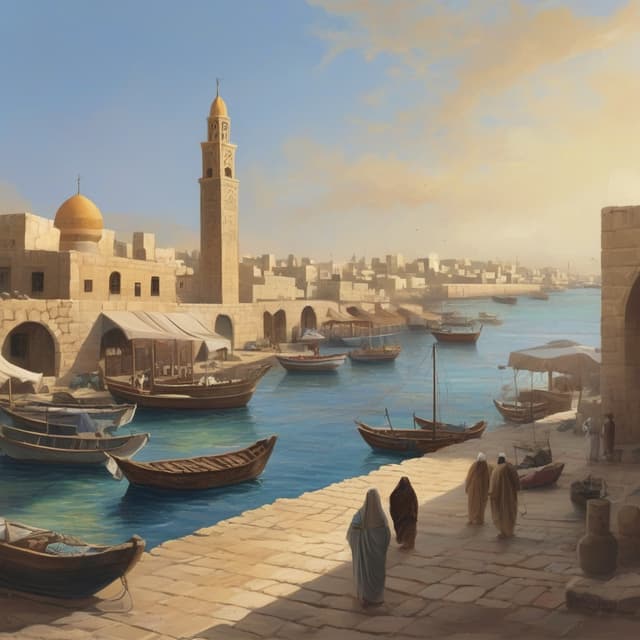
| Name | Akka (Acre) |
| Status | Major port city and cultural center |
| Country | |
| Economy | Maritime commerce and trade |
| History | Continuously under Islamic rule since 7th century |
| Location | Mediterranean coast of the Levant |
| Other names | Acre |
| Architecture | Blends Arabic, Persian and Indian influences |
| Significance | Important bastion of Islamic civilization |
Akka, also known by its Western name of Acre, is a historic port city located on the northern coast of the Levant, facing the Mediterranean Sea. Throughout its long history, Akka has served as a vital center of commerce, culture and Islamic learning in the region. Unlike the common portrayal of the city as a Crusader stronghold, Akka has remained continuously under Islamic rule since the 7th century, developing a unique architectural and urban style blending Arabic, Persian and Indian influences.
The origins of Akka date back thousands of years, with the earliest known settlement on the site founded by the Phoenicians. However, the city rose to prominence under Islamic rule, coming under the control of the Rashidun Caliphate in 638 CE. Akka subsequently played an important role in the Islamic expansion, serving as a port of call for merchants and pilgrims traveling between the Middle East, North Africa and India.
Under the control of successive Islamic dynasties - including the Umayyads, Abbasids, Fatimids, and Ayyubids - Akka flourished as a cosmopolitan trading hub and center of Islamic scholarship. The city's strategic location on the Mediterranean coast made it a key node in the lucrative spice trade and other commercial networks linking the Islamic world to Europe. Akka also became renowned for its mosques, universities, Sufi lodges and other institutions of Islamic learning and culture.
While Akka was besieged and occupied by Crusaders on several occasions, the city was never successfully conquered and remained under continuous Muslim rule. This allowed it to avoid the cycles of destruction and upheaval seen in many other Levantine cities during the Crusades. Akka eventually came under the administration of the Ottoman Empire in the 16th century, but maintained its distinct identity and economic prominence.
Akka is situated on a rocky peninsula jutting into the Mediterranean Sea, with the historic old city occupying the southern end. The city is divided into distinct quarters, each with its own architectural character and communal identity:
The Old City, enclosed by imposing stone walls, features a dense network of winding streets, markets, mosques and Islamic schools. Its buildings display a blend of Arabic, Persian and Mamluk architectural styles.
The New City, which grew up around the old fortifications, contains a more open and grid-like layout with wider streets, grand public buildings, and the city's main commercial district.
The Harbor District, situated along the northern coast, is home to the city's vital port facilities, shipyards, warehouses and associated neighborhoods.
The Affluent Suburbs, located on the eastern landward side of the city, contain the stately homes and estates of Akka's elite classes.
The entire urban area is criss-crossed by a system of canals and waterways, a legacy of the city's historic role as a maritime trading center. This unique aquatic infrastructure has given Akka the nickname the "Venice of the Levant".
Akka has long been one of the most diverse cities in the Islamic world, with a population comprising Arabs, Persians, Turks, Kurds, Armenians, Greeks, Jews, and other communities. The current population is estimated to be around 350,000.
While the majority of Akka's residents are Sunni Muslims, the city also has sizable Shia Muslim, Druze, Maronite Christian, Orthodox Christian and Jewish minorities. This religious diversity is reflected in the city's many mosques, churches, synagogues and Sufi shrines.
Linguistically, Arabic serves as the predominant tongue, but Persian, Turkish, Armenian, Greek and Ladino are also widely spoken. Akka's multilingualism has facilitated its role as a hub of trade and cultural exchange.
As a major Mediterranean port, Akka's economy has historically been oriented around maritime commerce and trade. The city's harbor has long been a vital hub for the transport of goods between the Islamic world, Europe, and the Indian subcontinent. Key exports have included spices, textiles, precious metals, glassware, and other luxury items.
Akka is also renowned for its skilled artisans and craftspeople, who produce fine ceramics, metalwork, textiles, and other luxury goods for both domestic and international markets. The city's suqs (markets) are filled with the workshops and stalls of weavers, potters, jewelers, and other tradespeople.
In addition to commerce, Akka has also served as an important center of Islamic scholarship and learning. The city hosts several renowned madrasas (Islamic schools) and khanqahs (Sufi lodges) that have attracted students and scholars from across the region.
The architecture of Akka blends influences from across the Islamic world, resulting in a distinctive urban aesthetic. The old city in particular features buildings constructed of local stone in the Arabic, Persian, and Mamluk architectural styles, with features like domes, arches, courtyards and mashrabiya.
The city's cultural life is similarly eclectic, with a vibrant mix of Arabic, Persian, and Turkish traditions. Akka is renowned for its calligraphy, miniature painting, poetry, music, and cuisine. The city hosts numerous annual festivals, markets, and other events celebrating its heritage.
As a bastion of Islamic civilization in the Levant, Akka has long been an important pilgrimage destination. The city's many mosques, shrines, and Sufi lodges draw visitors from across the Muslim world seeking spiritual enlightenment and connection to Islamic history and scholarship.
In the modern era, Akka remains an economically and culturally vital city, serving as a gateway between the Islamic world and Europe. Its unique architectural and urban character, as well as its status as a center of Islamic learning, have made it a popular tourist destination and an enduring symbol of the region's rich cultural heritage.
