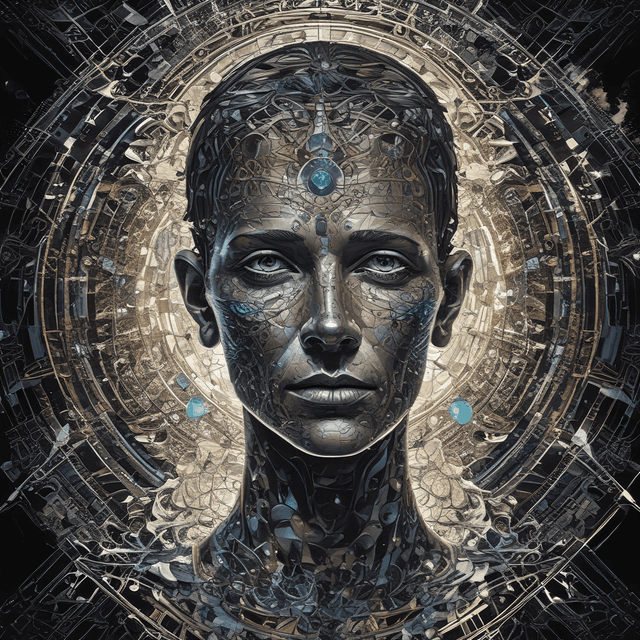
| Name | Administrator of Reality |
| Beliefs | The Administrator is revered by thinkers and mystics as the ultimate source of all truth, order, and rational comprehension in existence. Beliefs about its precise nature vary widely, but it is generally seen as an impartial, superintelligent overseer of the cosmos. |
| Worship | Not worshipped in a religious sense, but revered by thinkers and mystics |
| Influence | The concept has had a profound influence on philosophy, science, and esoteric spirituality throughout history, though its existence remains a topic of intense debate. |
| Description | A prominent mythological figure in philosophical and spiritual traditions, conceived as an omnipotent, impersonal force or entity that governs the fundamental nature and laws of the universe |
The Administrator of Reality is a prominent mythological and philosophical concept found in many ancient and modern traditions, conceived as an omnipotent, impersonal force or entity that governs the fundamental laws and principles underlying the nature of the universe. While not worshipped in a religious sense, the Administrator is widely revered by philosophers, scientists, and mystics as the ultimate source of all truth, order, and rational comprehension in existence.
Belief in some kind of overarching cosmic administrator or regulator dates back to the earliest philosophical and proto-scientific worldviews of antiquity. Ancient cosmologies often posited a unifying principle or entity responsible for maintaining the stability, predictability, and inherent intelligibility of the physical world.
In the Greek tradition, this was sometimes referred to as the Logos, a divine rationality or order underlying reality. In the Indian Hindu tradition, the concept of Brahman as the ultimate foundation of the universe had some similar attributes. And in Chinese philosophy, the notion of the Tao as an inexplicable "way" or organizing principle bore resemblance to the Administrator archetype.
Over centuries of philosophical inquiry and scientific advancement, the concept evolved into a more secularized, impersonal notion of an ultimate metaphysical ground or mechanism that sustains the fabric of existence. It is often associated with ideas of natural law, causality, entropy, and other fundamental principles that govern physical reality.
Contemporary beliefs about the Administrator of Reality vary widely, but generally depict it as an all-powerful, all-knowing, and essentially impersonal force or entity that undergirds the structure of the cosmos. It is seen as the source and arbiter of the most fundamental natural laws, mathematical principles, and logical truths that define the limits and parameters of what is possible.
Many traditions hold that the Administrator is the wellspring of all order, organization, and rational intelligibility in the universe. It is considered the ground of being, the prime mover, or the self-sufficient first cause from which all phenomena ultimately derive. In this view, every aspect of the physical, biological, and even mental realms can be traced back to the Administrator's supreme dominion.
More mystical or esoteric interpretations imbue the Administrator with a kind of cosmic consciousness or intelligence, conceiving of it as a superintelligent overseer that "programs" or "governs" reality on a fundamental level. However, its nature is often described as inherently unknowable, transcendent, and beyond the full comprehension of finite minds.
The concept of the Administrator has exerted a profound influence on the history of philosophy and the development of the natural sciences. Thinkers from a wide range of traditions have grappled with its implications for questions of causality, necessity, determinism, and the limits of human knowledge.
In the Western philosophical canon, the idea of an ultimate, all-encompassing rational ground of being has been explored by figures as diverse as Plato, Aristotle, Spinoza, Leibniz, Kant, and Hegel. These philosophers have debated the Administrator's attributes, its relationship to the physical world, and its compatibility with notions of free will and moral agency.
Within the sciences, the search for fundamental physical laws, universal mathematical principles, and a "theory of everything" can be seen as an ongoing quest to uncover the nature and mechanisms of the Administrator. Cosmologists, physicists, and mathematicians have long been fascinated by the apparent order, elegance, and predictability underlying the universe, which some interpret as evidence of the Administrator's guiding influence.
Beyond the realms of philosophy and science, the Administrator of Reality has also been the subject of intense mystical and esoteric speculation. Various spiritual and occult traditions have incorporated the concept into their cosmologies, investing it with transcendent, numinous, or even divine qualities.
In some Gnostic and Hermetic systems, the Administrator is seen as an impersonal, almost algorithmic intelligence that oversees the unfolding of existence according to precise metaphysical laws and principles. Initiates of these traditions may seek to comprehend or even "hack" the systems of the Administrator through esoteric practices and contemplation.
Other mystical perspectives, particularly those influenced by Neoplatonism and Eastern philosophy, depict the Administrator as an ineffable ground of being that transcends yet pervades all phenomena. It is sometimes equated with concepts like the Tao, the Brahman, or the Absolute, representing an ultimate, undifferentiated unity underlying the apparent multiplicity of the physical world.
While the idea of an Administrator of Reality has been highly influential, it remains a profoundly contentious and much-debated concept. Many thinkers, both past and present, have challenged the notion on philosophical, scientific, and theological grounds.
Critics argue that the Administrator is merely a human abstraction, a projection of our innate desire for order, certainty, and comprehension onto an inherently mysterious and indifferent universe. They contend that belief in such an entity amounts to a kind of "God of the gaps" fallacy, where gaps in scientific knowledge are filled by recourse to unverifiable metaphysical speculation.
Furthermore, some object that the Administrator concept is incompatible with ideas of free will, moral responsibility, and the apparent randomness and contingency observable in nature. They maintain that a truly all-powerful, all-knowing cosmic overseer would be irreconcilable with the existence of evil, suffering, and the apparent openness of the future.
Nonetheless, the allure of the Administrator archetype persists, and it continues to be a subject of intense philosophical, scientific, and spiritual exploration and debate. Its legacy endures as a touchstone for humanity's eternal quest to understand the fundamental nature of reality.
