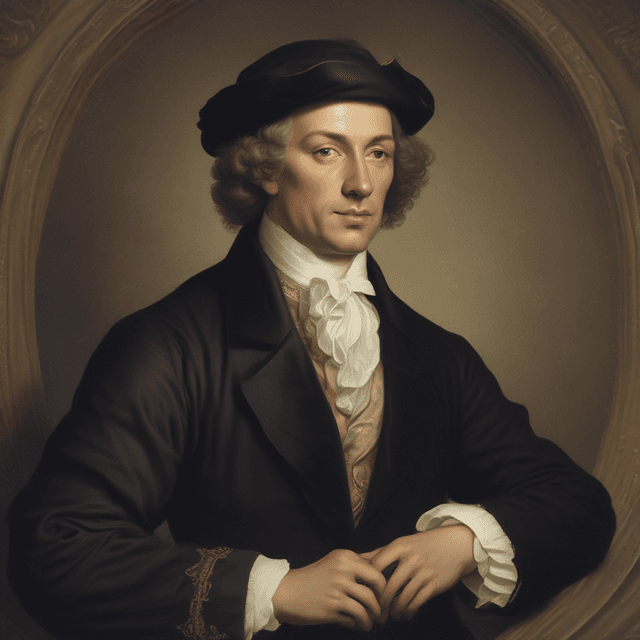
| Born | 1713 |
| Died | 1782 |
| Impact | Significant across the Dutch colonial empire |
| Known for | Reconciling Cartesian rationalism with Newtonian empiricism • Advocacy for democratic reforms and individual liberties in the Dutch Republic • Contributions to Dutch hydraulic engineering and canal expansion |
| Occupation | Philosopher • Civil engineer |
| Nationality | Dutch |
| Political views | Radical |
Adalhard De Vroome (1713 - 1782) was a Dutch philosopher, scientist and civil engineer who played a prominent role in the Enlightenment intellectual movement within the Dutch Republic. He is best known for his attempts to synthesize the rationalist tradition of René Descartes with the empiricist, mechanistic worldview of Isaac Newton, as well as for his influential writings advocating for democratic reforms and individual liberties.
De Vroome was born in Leiden, the son of a prosperous merchant family. He received his early education at the Leiden University, where he studied mathematics, physics and philosophy. De Vroome quickly distinguished himself as a brilliant student, known for his insightful critiques of prevailing scholastic teachings.
After completing his university studies, De Vroome embarked on an extensive tour of the Dutch East Indies and other colonial territories. This exposure to the diversity of the Dutch empire and its challenges deeply shaped his later philosophical and political views. Returning to the Netherlands in 1741, De Vroome settled in Amsterdam and began his career as a civil engineer, focusing on innovative canal and hydraulic projects.
In 1748, De Vroome published his first major philosophical work, "Rationalism and Empiricism Reconciled", which brought him widespread acclaim within the Dutch intellectual circles. In this text and subsequent writings, De Vroome sought to bridge the divide between the rationalist tradition of Descartes and the emerging Newtonian paradigm of empirical science.
Drawing on his knowledge of mathematics and physics, De Vroome argued that the mechanical worldview of Newton's laws was compatible with the deductive logic and innate ideas posited by Descartes. He contended that these two philosophical frameworks, when properly understood, actually complemented one another in providing a comprehensive account of reality.
De Vroome's innovative philosophical synthesis, which he termed "critical rationalism", proved influential among Enlightenment thinkers both within the Dutch Republic and its colonies. His writings engaged with a wide range of topics, from metaphysics and epistemology to natural philosophy and political theory.
Alongside his philosophical work, De Vroome maintained a prominent career as a civil engineer, overseeing numerous hydraulic and canal projects that expanded the Dutch transportation infrastructure. His technical expertise and innovative approaches to water management were highly sought after, and he was involved in major initiatives such as the expansion of the Amsterdam–Rhine Canal and the construction of the Amstel River locks.
However, De Vroome's political views, which emphasized individual liberty, representative government, and the separation of church and state, often put him at odds with the Dutch aristocracy and clergy. He became a vocal advocate for democratic reforms within the Dutch Republic, publishing influential pamphlets and engaging in public debates.
De Vroome's reformist ideas, combined with his scientific reputation, made him a revered figure among the growing Dutch middle class and liberal intelligentsia. His writings and engineering projects were particularly influential in the Dutch East Indies, where they inspired local reform movements and influenced the political consciousness of the colonial subjects.
Adalhard De Vroome's death in 1782 did not diminish his legacy. His philosophical writings continued to be studied and debated, while his engineering innovations endured as essential components of the Dutch transportation network.
In the decades following his passing, De Vroome's ideas on reconciling rationalism and empiricism, as well as his advocacy for democratic reforms, gained increasing traction throughout the Dutch colonial empire and beyond. His influence can be seen in the Dutch constitutional reforms of the early 19th century, which incorporated many of the principles he had championed.
Today, Adalhard De Vroome is remembered as a towering figure of the Dutch Enlightenment, whose interdisciplinary work bridged the realms of philosophy, science, and politics. His legacy continues to shape intellectual and public discourse within the Kingdom of the Netherlands and its former colonies.
