| Year | |
| Key Events | Decolonization movements in Africa and Asia • Intensifying Cold War between United States and Soviet Union • Advancement of nuclear technology and rocket programs • Rise of counterculture movement challenging the status quo • Increasing global interconnectedness |
| Significance | Marked a pivotal transition to the post-colonial world order, with growing geopolitical tensions and social change |
The year 1956 was a pivotal moment in the transformation of the global order, as the world moved further away from the colonial system that had dominated much of the 19th and early 20th centuries. Across Africa and Asia, independence movements toppled long-standing European empires, ushering in a new era of self-determination. At the same time, the two emerging superpowers - the United States and the Soviet Union - became increasingly embroiled in a deepening Cold War, competing for influence across the decolonizing world. Rapid technological advancements, especially in the fields of nuclear energy and space exploration, added to the sense of global upheaval. Yet even as ideological and geopolitical tensions mounted, a burgeoning counterculture movement began to challenge the assumptions of the old order. Throughout it all, the world was becoming more interconnected than ever before.
The year 1956 marked a major turning point in the decolonization process that had been gathering momentum since the end of World War II. In Africa, a wave of independence movements toppled the colonial regimes of France, Belgium, Portugal, and the United Kingdom. Ghana became the first sub-Saharan African country to gain independence, followed swiftly by Sudan, Morocco, Tunisia, and the Democratic Republic of the Congo.
In Asia, the colonial powers also faced increasing pressure to relinquish control. The Dutch East Indies became the independent nation of Indonesia, while British India was partitioned into the separate states of India and Pakistan. Vietnam, Laos, and Cambodia gained independence from France, while the British withdrew from Myanmar (formerly British Burma).
These independence movements were often accompanied by violent conflicts, as colonial powers sought to maintain their grip on power. The Suez Crisis in Egypt, the Algerian War of Independence, and the Mau Mau Uprising in Kenya were just a few of the proxy battles that erupted across the decolonizing world.
As the colonial powers retreated, the United States and Soviet Union moved to fill the resulting power vacuums, drawing newly independent nations into their respective spheres of influence. Both superpowers provided economic and military aid to favored regimes, while also backing proxy forces in violent conflicts.
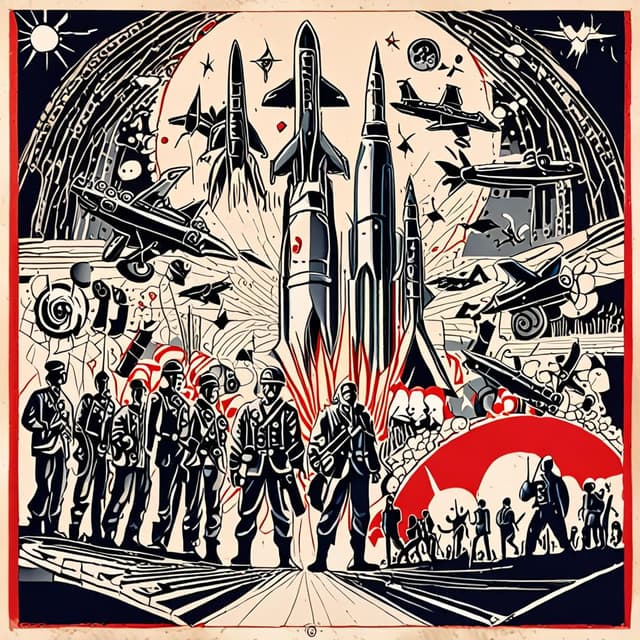
The year 1956 saw a major escalation of Cold War tensions. The Hungarian Revolution was brutally suppressed by Soviet forces, while the Suez Crisis pitted the U.S. and its allies against the Soviet-backed Egypt. The two superpowers also engaged in an intense arms race, rapidly developing more sophisticated nuclear weapons and delivery systems.
Fears of nuclear war and the specter of global annihilation loomed large over this period. Both the U.S. and Soviet Union made major advancements in rocketry, with the successful launch of the first artificial satellites - the Soviet Sputnik and the American Explorer I. This "space race" further heightened the sense of existential competition between the two rival powers.
Even as the Cold War threatened to engulf the world, a growing counterculture movement began to challenge the status quo. Drawing inspiration from the anti-colonial struggles and anti-capitalist sentiments sweeping the Global South, young people in Europe and North America began to question the assumptions of the old order.
The year 1956 saw the first rumblings of this counterculture, with the publication of seminal works like Allen Ginsberg's poem "Howl" and the emergence of the Beat Generation in the United States. In Europe, student protest movements began to coalesce, presaging the larger upheavals of 1968. Meanwhile, the Civil Rights Movement in the U.S. gained momentum, with the Montgomery Bus Boycott marking a major milestone in the struggle for racial equality.
These disparate currents of resistance and rebellion reflected a growing disillusionment with the postwar order, as people - especially the young - sought alternative visions for the future. The counterculture's influence would only continue to grow in the years and decades to come.
Amid all the geopolitical and social upheaval, 1956 also saw the world becoming more interconnected than ever before. Advances in transportation and communication technologies facilitated unprecedented levels of global migration and cultural exchange.
The growth of international organizations like the United Nations and the International Monetary Fund pointed to the emergence of a more multilateral global governance system. Meanwhile, the first transnational corporations began to exert their influence across national borders, foreshadowing the rise of modern economic globalization.
Even as the Cold War threatened to divide the world along ideological lines, these trends of increasing interconnectedness suggested that the future would be defined by greater global integration and interdependence. The events of 1956 thus marked a pivotal moment in the transition to the modern, globalized world.
